
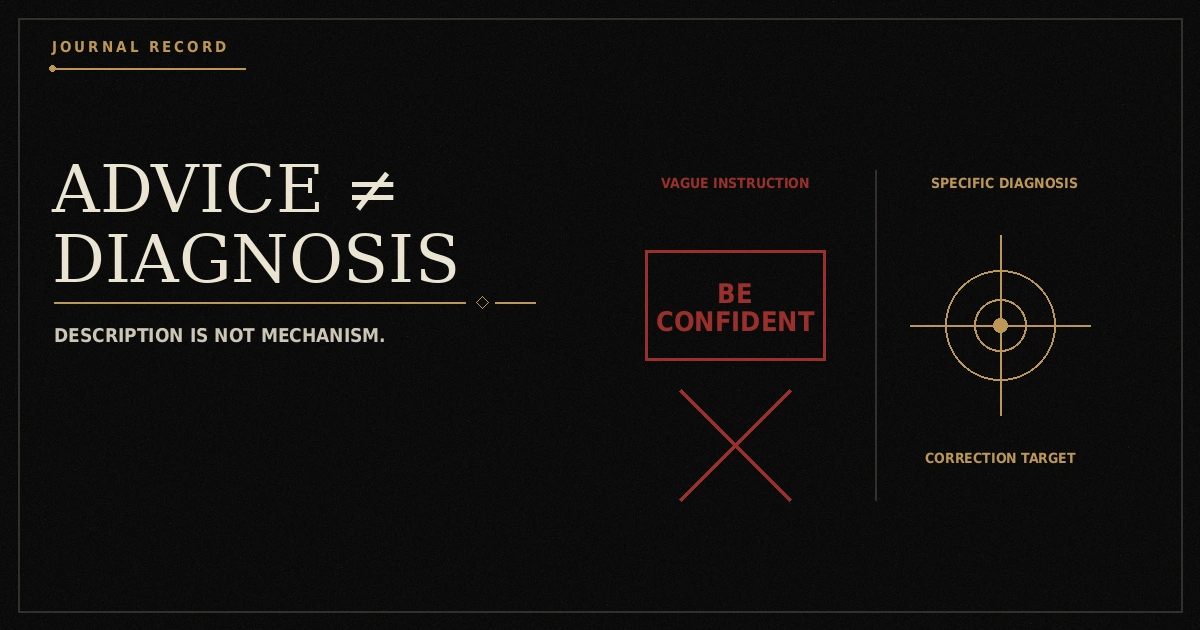
Most advice in this space operates the same way: name a common mistake, describe what the correct behavior looks like, move on. “Don’t text too much.” “Be confident.” “Don’t seem needy.” Each of these is accurate as far as it goes — and each of them fails to change behavior for a specific, structural reason: they describe an outcome, not a mechanism.
Observation vs. diagnosis
Observation names what happened. “He came on too strong” is an observation — accurate, and useless on its own, because it doesn’t say why it happened or what to do instead in the moment it’s happening again. Diagnosis identifies the mechanism: which specific behavioral variable failed, and under what conditions. “He came on too strong because Attention Control had migrated entirely to monitoring her response, producing Perceived Value Drop” is a diagnosis — it points directly at a correction, because it names the actual thing that needs to change.
Nearly all generic advice operates at the observation layer. It’s not wrong, exactly — it’s incomplete in a way that makes it hard to apply.
Why the same tip helps one person and does nothing for another
Two men can produce the identical visible mistake — over-texting, say — for two completely different underlying reasons. One is doing it from Validation Debt: each message is an attempt to resolve the discomfort of not knowing where things stand. The other is doing it from Reactive Drift: a standard that used to hold has quietly eroded over several weeks, and over-texting is just the current shape of that erosion. “Text less” is the correct-sounding tip for both — and it addresses the actual cause for neither. The first man needs to interrupt the specific impulse to seek reassurance. The second needs to identify where his standard drifted and return to it. Same visible symptom, different correction, and a generic tip can’t tell them apart because it was never built to.
What diagnosis actually requires
A working diagnostic framework needs at least three things generic advice usually skips: a small number of named mechanisms (not one giant category called “confidence”), a way to tell which mechanism is active in a specific situation, and a correction that’s specific to that mechanism rather than to the visible symptom. This is the entire reason the RCM is built around five variables and four failure modes instead of one broad idea like “be more secure.” A framework with five distinguishable parts can point at which one is actually failing. A single broad concept can’t.
Why this isn’t a claim that advice is useless
None of this is an argument against advice in general — it’s specifically about the difference between advice that names a mechanism and advice that names an outcome. “Run the Decision Filter before responding when you feel the urge to seek reassurance” is still advice. It’s just advice built on a diagnosis rather than skipping straight to a description of the desired end state.
Where to start if you want the diagnostic version
The RCM page has the complete framework — the two states, five variables, four failure modes, and the Decision Filter used to catch the reactive moment in real time. 101 Mistakes Men Make With Women applies it to 101 specific, named situations, each mapped to its actual mechanism rather than described only by its symptom.