
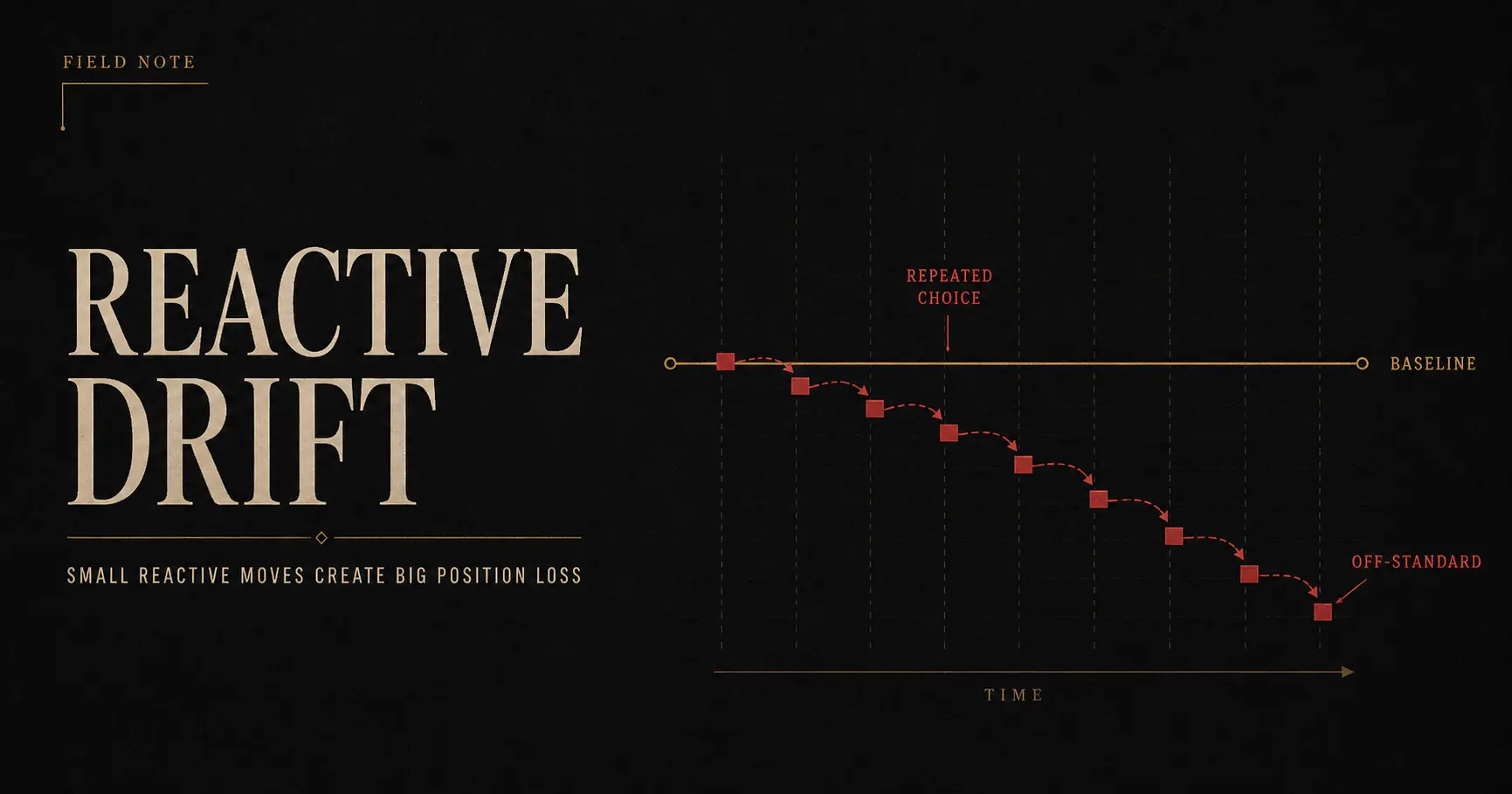
The pattern is familiar to anyone who’s noticed it: the same relationship mistake, in a slightly different costume, across a string of different situations. Not identical each time — close enough that it’s obviously the same underlying thing wearing a new outfit. In the Reactive–Control Model, this has a name: Reactive Drift, Failure Mode 3.
What Reactive Drift actually is
Reactive Drift is a slow slide, not a sudden collapse. It’s the gradual erosion of Behavioral Consistency (V3) — the variable that governs how little a standard changes in response to input that wasn’t chosen. Drift means the floor moves. What used to be “I don’t reply within five minutes of getting a text” quietly becomes “I don’t reply within five minutes, except when she seems distant, in which case I do.” The exception becomes the rule the next time a similar situation shows up, and the standard has moved without ever being consciously renegotiated.
This is what separates Reactive Drift from a single reactive moment. A one-off reaction is a Frame Collapse — a spike under acute pressure. Drift is what happens when nobody catches the spike, so it becomes the new resting position.
Why it’s hard to notice from the inside
Drift is gradual by definition, and gradual change is exactly the kind of change human attention is bad at detecting. Each individual adjustment feels reasonable in isolation — “just this once,” “this situation is different,” “it’s not a big deal.” The RCM’s position is that none of those adjustments are lies, exactly. They’re just each one small enough to not register as a change in standard, even though the sum of them is.
The result: a man who would say, if asked directly, that he holds a consistent standard — while his actual behavior over the last month tells a different story than his stated one.
A concrete example
Consider a common version of the pattern: a man decides he won’t be the one to always initiate contact. The first week, he holds it. The second week, there’s a day where the silence feels uncomfortable, so he sends a message — “just to check in, not a big deal.” The exception gets rationalized. By week four, initiating first is simply what happens whenever the silence gets long enough, and the original standard is gone — not broken in one dramatic moment, but drifted out of existence one exception at a time.
Nothing about this requires bad intent. It requires exactly what most people have by default: no explicit mechanism for noticing when today’s behavior has quietly diverged from last month’s stated standard.
How to catch it
Catching drift requires comparing behavior across a longer window than any single interaction — which is exactly what makes it hard to do from memory alone. The Control Scale self-assessment is one entry point: scoring V3 honestly, on its own, separate from the other four variables, forces the question “has this actually held, or has it moved?”
A more direct method, drawn from the RCM’s Failure Mode Quick Guide: identify the last three adjustments made in the past 48 hours, and ask, for each one, whether it came from an internal standard or from her response. If most of them trace back to her response, the floor has already started to slide — and the useful move isn’t guilt about it, it’s returning to the original baseline before the next exception compounds it.
The correction isn’t willpower
The temptation is to treat drift as a discipline problem — try harder, care more, don’t give in next time. The RCM’s framing is different: drift is a detection problem before it’s a discipline problem. A standard that isn’t being actively measured against actual behavior will drift, for the same reason anything unmeasured drifts. The fix isn’t more willpower in the moment; it’s a periodic, explicit check of whether this week’s behavior matches the stated standard — the same way the Decision Filter checks a single decision in real time.
This is also why 101 Ways Men Lose Her Without Knowing Why is structured across a seven-stage timeline rather than as a flat list: Reactive Drift is fundamentally a pattern that only shows up when you’re looking across time, not at any single moment in isolation.