

01 / Texting & uncertainty
She Takes Hours to Reply: Is She Busy or Losing Interest?
The timestamp is visible. Her reason isn't. Here's how to separate a slow reply from a fading connection.
Read the field note 11 min readPlayBook Archive / Relationships, patterns, decisions
A reply you keep checking. A date that went quiet.
A boundary you keep moving.
Read what the situation tells you—and what it doesn’t. Illustrated field notes, deeper analysis, and practical tools for men who want to stop guessing.
Illustrative scene / Not evidence of intentCase 01 / Read the pattern
Read the whole pattern before deciding what the delay means.
Read the full field note Illustrative scene / Not evidence of intent
Case 02 / Read the pattern
Separate an enjoyable conversation from a connection that is moving forward.
Read the full field note Illustrative scene / Not evidence of intent
Case 03 / Read the pattern
Read how to discuss a boundary without turning it into a demand for control.
Read the full field note PILLAR POSTARCHIVE ATLAS / 001
The pillar post / Your map of the archive
A visual guide to nine categories of recurring mistakes. See how the patterns connect, examine a reference entry, and use the free mistake-audit worksheet.
Read the complete pillar postLooking for the wider picture? Read: Why Dating Is So Hard for Average Men
The Journal / Seven field notes to start with
Free, illustrated analysis built around questions readers actually face.
Browse all 22 articles01 / Texting & uncertainty
The timestamp is visible. Her reason isn't. Here's how to separate a slow reply from a fading connection.
Read the field note 11 min read02 / Attention & reciprocity
Warm messages can feel like attraction. Here's how to tell whether the connection is actually moving forward.
Read the field note 12 min read
03 / After the first date
The evening felt right. The follow-up did not. Separate the chemistry you experienced from the second date that has not been agreed.
Read the field note 11 min read
04 / Attraction & blind spots
Chemistry can make a warning sign feel negotiable. Learn to separate ordinary incompatibility, repeated harmful behavior, and immediate safety concerns.
Read the field note 14 min read05 / Boundaries & connection
A clear limit protects your participation. It is not a demand to control hers.
Read the field note 13 min read
06 / Pillar analysis
The problem isn't one universal flaw. Different stages create different obstacles—and each requires a different response.
Read the field note 13 min read
07 / Kindness & the hidden contract
Being kind is a standard of character, not a deposit toward romance.
Read the field note 12 min readFramework guides / The foundations
Three connected guides explain the framework behind the Journal, the tools, and every manual.
Understand the framework
The complete introduction: two operating states, five variables, and a way to examine your next response.
Read the complete guideUnderstand the process
Trace how a situation becomes a reaction—and where a pause can change what you do next.
Read the complete guideUnderstand the timeline
Follow recurring patterns from first contact through commitment, pressure, and recovery.
Read the complete guideA practical example / The Reactive–Control Model
The useful question is what you do with uncertainty. A response time alone does not tell you what someone thinks.
The reactive loop
The action is driven by the need for an immediate answer.
A more deliberate response
You can make a decision without pretending to know her intentions.
That is the distinction the archive helps you examine.
Explore the complete model Test your judgment in a case fileCase Files / Three illustrated decisions
Examine the evidence, choose a response, then reassess when new information appears. Each case lets you test the way you reach a conclusion.
Explore the Case Files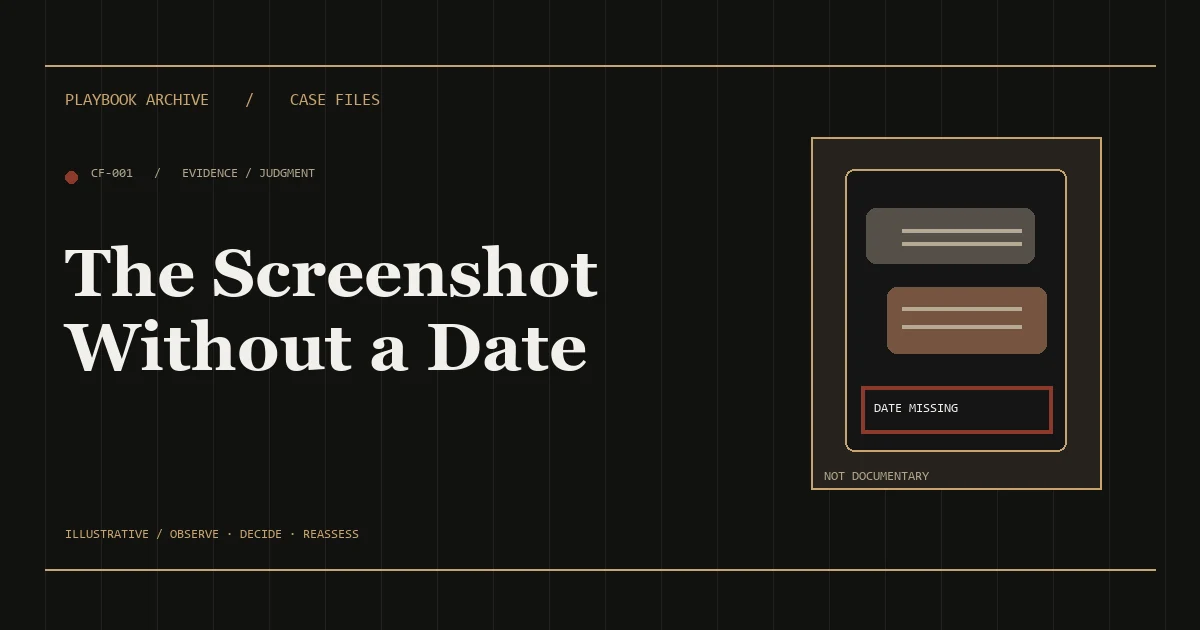 Evidence / Decision / Reassessment
The 101 Series / Digital reference manuals
Choose by the question you want answered. Both manuals stand alone. Each includes its corresponding Field Companion.
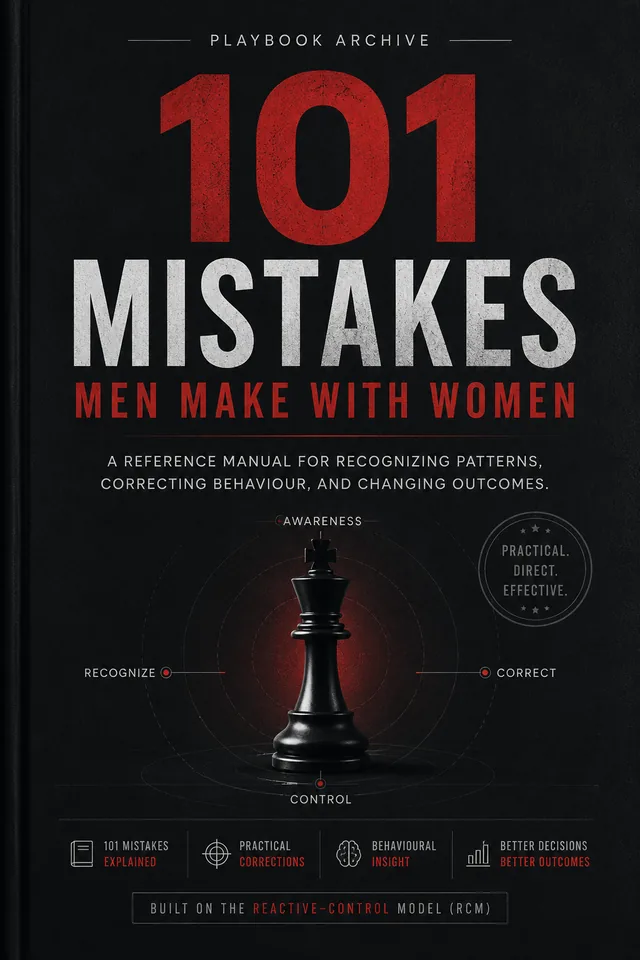
RM-001 / Find the mistake
“What am I doing that keeps going wrong?”
Look up a specific behavior across communication, texting, presence, dating, and emotional patterns.
101 entries · 9 sections
Digital manual · Field Companion included
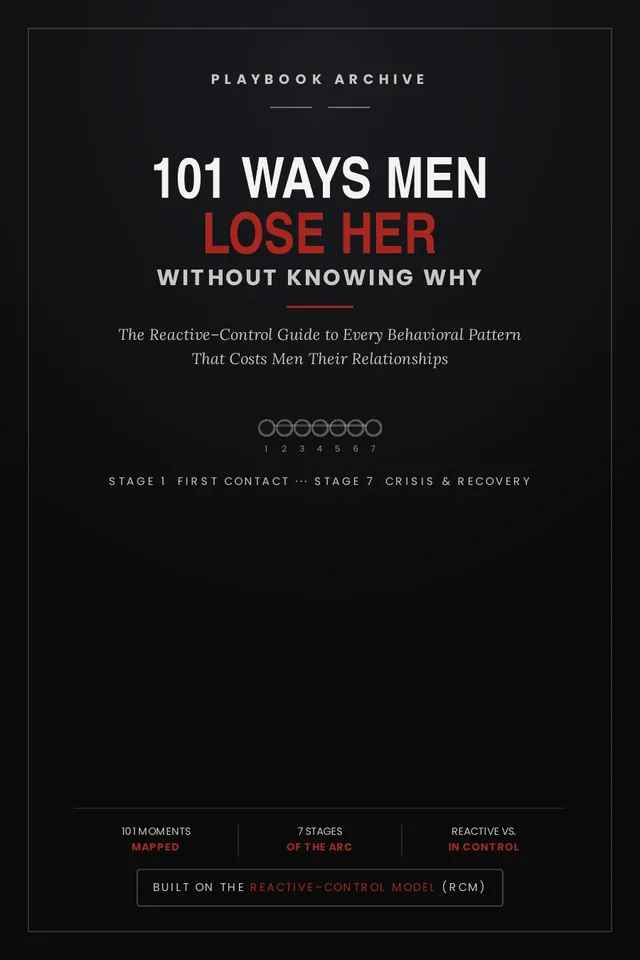
RM-002 / Find where it changed
“Where did the relationship start to shift?”
Follow the patterns across seven stages, from first contact to long-term pressure and recovery.
101 moments · 7 stages
Digital manual · Field Companion included
Both perspectives / One package
Both digital manuals and their corresponding Field Companions. Choose this when you want the category reference and the relationship timeline.
Checkout opens on Gumroad. Applicable taxes, regional discounts, currency options, and the final total are shown there before payment.
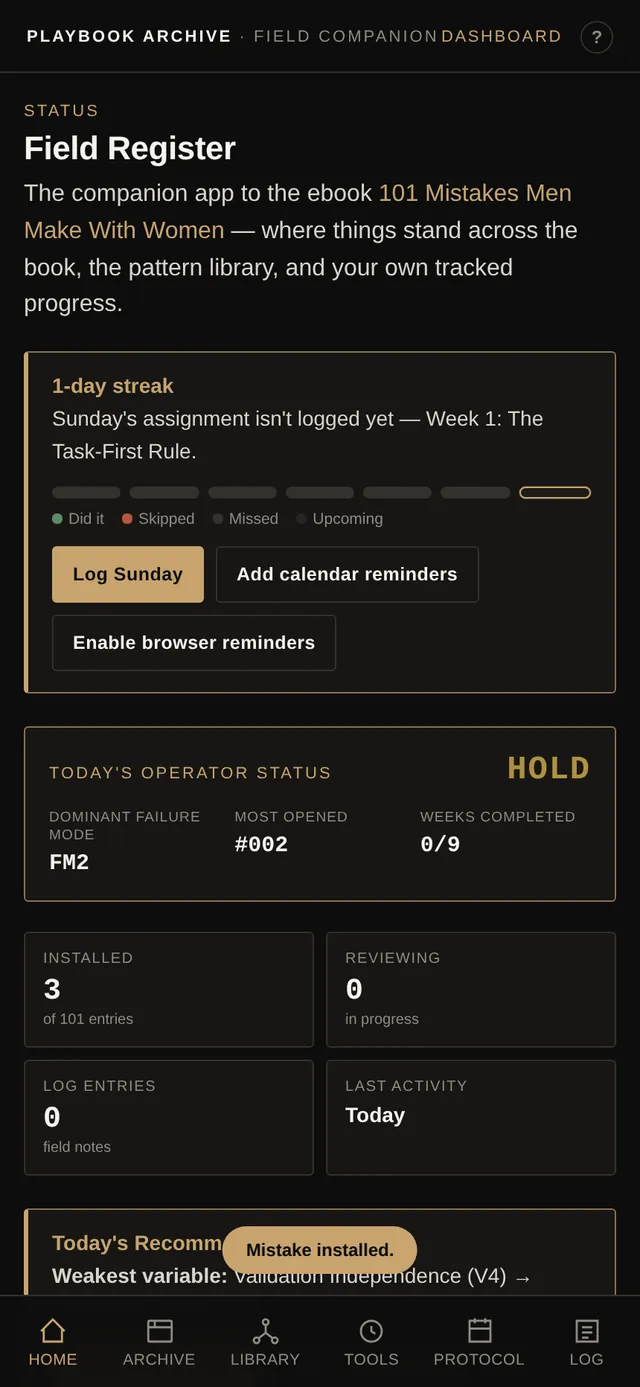
Included with each manual / The Field Companion
Use the matching companion to find relevant entries, reflect on your response, and keep a record of real situations.
Prefer to try a tool first? Take the free Control Scale · About 2 minutes · No account required.
Before you decide
Yes. The Journal, pillar guides, case files, and standalone Control Scale are free to explore. Start with an article that matches your situation. No purchase is required to understand the framework.
Choose 101 Mistakes if you want to look up a specific behavior by category. Choose 101 Ways Men Lose Her if you want to follow patterns across a relationship’s timeline. Each stands alone; both use the same framework.
A digital reference manual plus the corresponding Field Companion. Confirm the current downloadable formats on the Gumroad listing before payment. The companion helps you review entries, use the Decision Filter, and record real situations. These are digital products, not printed books.
Purchase buttons open Gumroad checkout. Review your currency, applicable taxes, regional discounts, and final total there before paying. Delivery and the applicable purchase terms are provided through Gumroad.
No. These are educational frameworks for examining your own decisions, not a clinical assessment or a promise about someone else’s behavior. A self-rating is a reflection tool, not a psychological diagnosis.
Your next step
Read freely. Try a tool. Buy a reference when you want the depth.