
Listen to this Atlas
Hear all nine categories and their explanations. Your device supplies the voice; no recording or account is required.
Find the pattern before you correct the mistake.
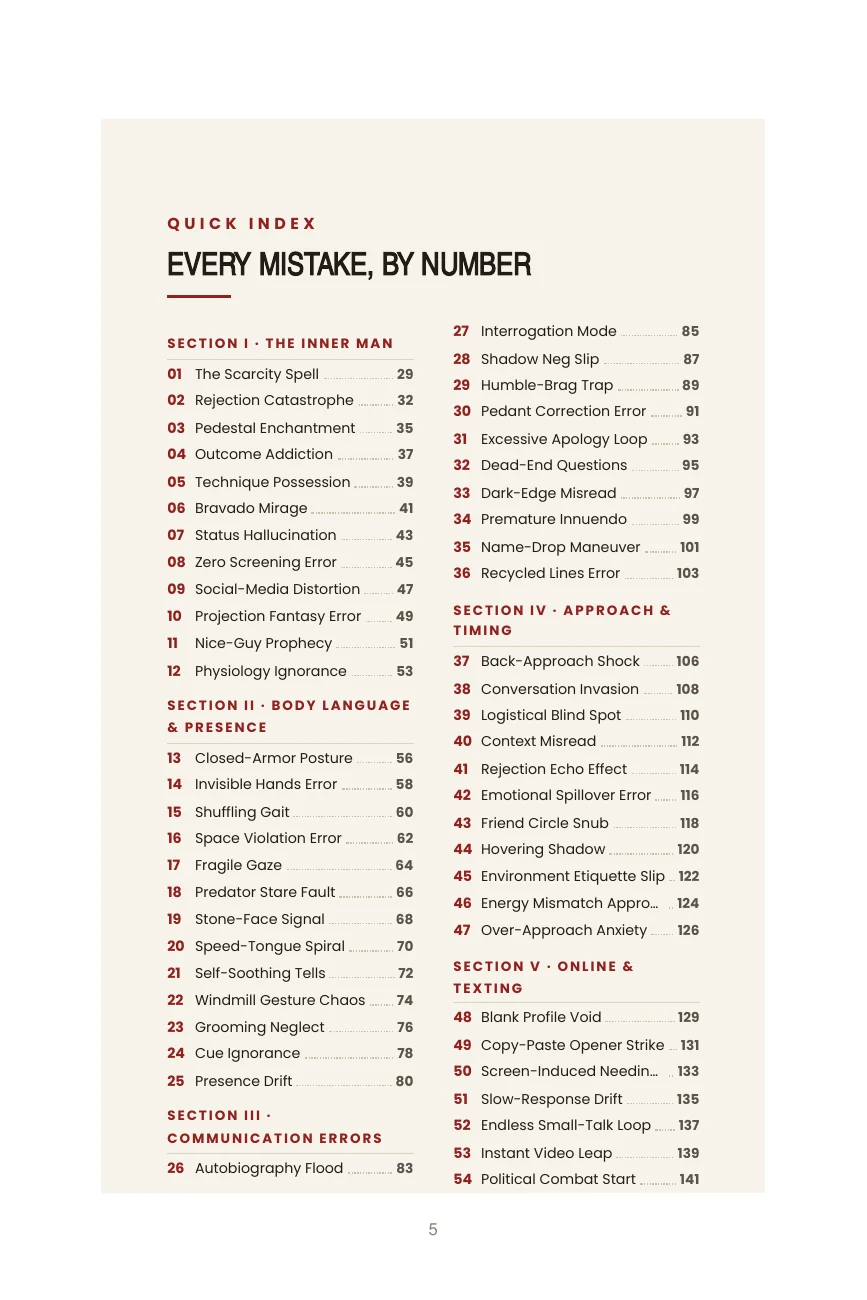
Nine distinct categories organize the 101 entries in Reference Manual 001. Read them as a practical guide, not as nine personality labels. Pick one behavior you can observe, identify the circumstances, and test a correction.
The mistake before the mistake.
He has spoken to her twice. He already imagines a relationship. He rearranges his weekend in case she becomes available and begins overlooking things he would normally consider important.
Nothing has been agreed upon. Yet he behaves as though something valuable is already at risk. An internal assumption has started controlling external decisions.
Mistake 8 · Zero Screening Error — Seeking to be chosen without examining compatibility.
The common error is not feeling attraction. It is treating an imagined future as a current obligation. When every decision is organized around keeping one possibility alive, the other person's real qualities become secondary.
A correction begins with ordinary evaluation: What have you actually learned? Are your priorities compatible? Would you tolerate this behavior from somebody you were not trying to impress? Your answer should reflect available information, not the fear of losing an opportunity.
Attraction is a reason to investigate. It is not permission to abandon your standards.
Your attention is showing.
She mentions she needs to rejoin her friends. You nod and continue the story. Her replies shorten. She adjusts her position. You keep talking.
The issue is no longer the story. You have stopped responding to the situation taking place around you.
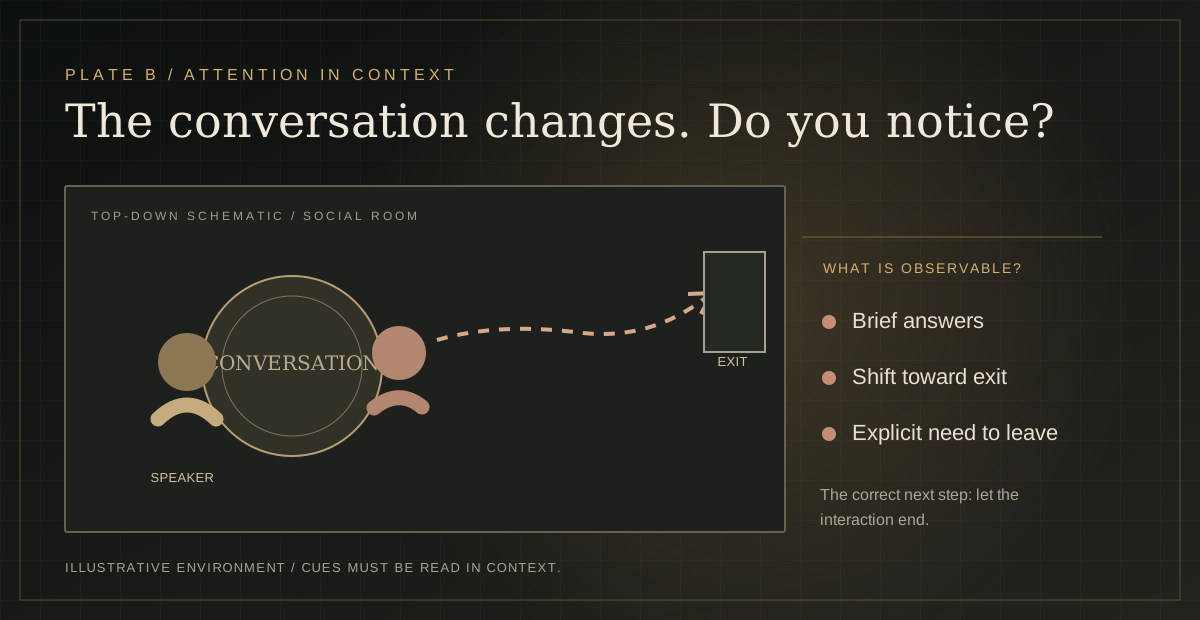
A gesture is not a universal code. Looking away does not prove rejection, and folded arms do not establish insecurity. Read context and explicit communication together. If someone needs to leave, let the interaction end.
Presence is not a rehearsed pose or permanent eye contact. It is enough awareness to recognize when the situation has changed.
The conversation you accidentally took over.
Some men occupy all the conversational space with stories. Others ask a new question each time the previous answer ends. Both approaches can become ways of managing silence rather than listening.
Autobiography Flood — Mistake 26 turns a modest question into an extended account of your background. Interrogation Mode — Mistake 27 turns conversation into a series of disconnected questions.
The conversation that became an interview.
Switch between the event, a possible diagnosis, and a practical correction.
Suppose she says she has moved into design. A question-driven speaker immediately asks where she lives. A more attentive speaker asks what prompted the change, then listens to the answer. This is not a magic line; it is a different use of attention.
An exchange needs room for both people. Asking a new question every few seconds may keep words moving while preventing a subject from developing. The correction is to allow pauses, respond to the information offered, and share something of your own only when it belongs in the conversation.
The useful correction is to develop an answer before jumping to another question. The aim is a genuine exchange, not a memorized script designed to obtain a particular reaction.
Context comes before confidence.
Approaching someone who is already engaged in a private conversation is different from speaking during a natural pause at a social event. The words might be equally polite. The circumstances are not.
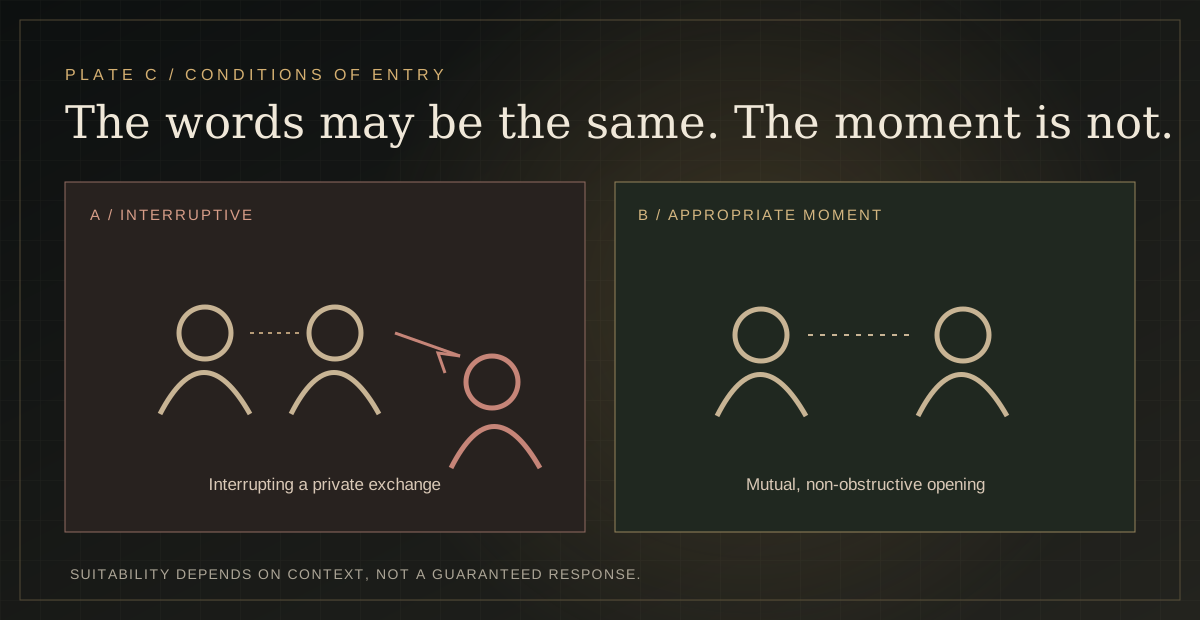
A person rushing to transport, speaking privately, or concentrating on work is not required to reorganize the moment around your introduction. The conditions of an approach matter independently of its wording.
Assess whether conversation is welcome, whether your entry blocks anyone's movement, and whether the other person can comfortably decline. If the context does not support an approach, choosing not to interrupt is a competent decision, not a loss of nerve.
The manual's Mistake 38 · Conversation Invasion and Mistake 37 · Back-Approach Shock describe preventable errors of entry and timing. Before deciding what to say, decide whether the moment is suitable for saying anything.
Two opposite habits. One shared problem.
He receives a message at 2 p.m. He waits six hours to reply because he wants to appear detached. Another man sends three follow-ups because a reply has not arrived. One performs indifference; the other attempts to relieve uncertainty.

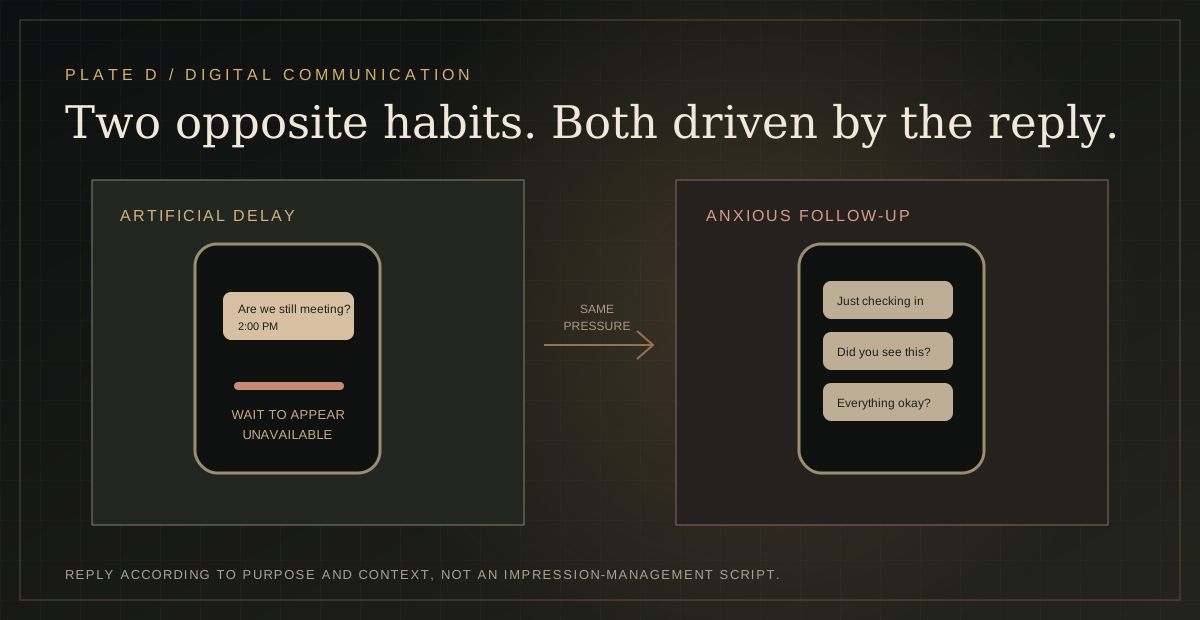
Mistake 52 · Endless Small-Talk Loop — Continuing exchanges without meaningful direction.
There is no universal reply schedule. Respond when reasonably possible, communicate with purpose, and avoid interpreting incomplete information as confirmed motive.
A boundary violation is not just an awkward mistake.
Some errors are inconvenient or embarrassing. Others disregard another person's autonomy. Uninvited touch, blocking movement, and continuing after a clear refusal belong to the second group.
The manual covers Mistake 63 · Uninvited Touch Error and Mistake 64 · Persistence Trap. A refusal ends an invitation. Politeness and silence are not consent. Confidence is irrelevant if the other person's boundaries are being ignored.
Not every mistake has equal stakes. A weak joke or misplaced question may create mild awkwardness. Touching someone without permission or pursuing them after a clear refusal is a violation of their boundary. It demands an immediate stop, not a revised technique.
Social calibration begins with recognizing that your interest does not establish someone else's willingness. Politeness, silence, or nervous laughter are not permission. A refusal settles the issue even when your intentions were friendly.
Your actions become your record.
Monday, you propose a Saturday plan. Wednesday, you promise to confirm the details. Friday, there is still no information. Saturday morning, you ask whether the date is happening.
To you, this may be minor scheduling friction. To the other person, it is uncertainty created by an agreement you initiated.
Mistake 75 · Triple-Text Spiral — Repeatedly messaging to secure a reply.
Neither constant availability nor artificial distance establishes reliability. Make commitments you intend to keep, communicate changes promptly, and allow the other person to decide without pressure.
The maintenance you stopped noticing.
Some details need no complex psychological explanation. Clean clothes, appropriate footwear, dental care and restrained use of fragrance can be checked before leaving home.
Fragrance is optional and preferences differ. If used, it should remain considerate in shared environments. The goal is an appropriate baseline of care, not a performance of wealth, masculinity, or flawless appearance.
Entries such as Mistake 83 · Footwear Disarray, Mistake 86 · Dental Health Debt, and Mistake 90 · Fragrance Assault concern practical preparation. Fragrance itself is optional; basic cleanliness and consideration matter more than any particular product.
When the story replaces the evidence.
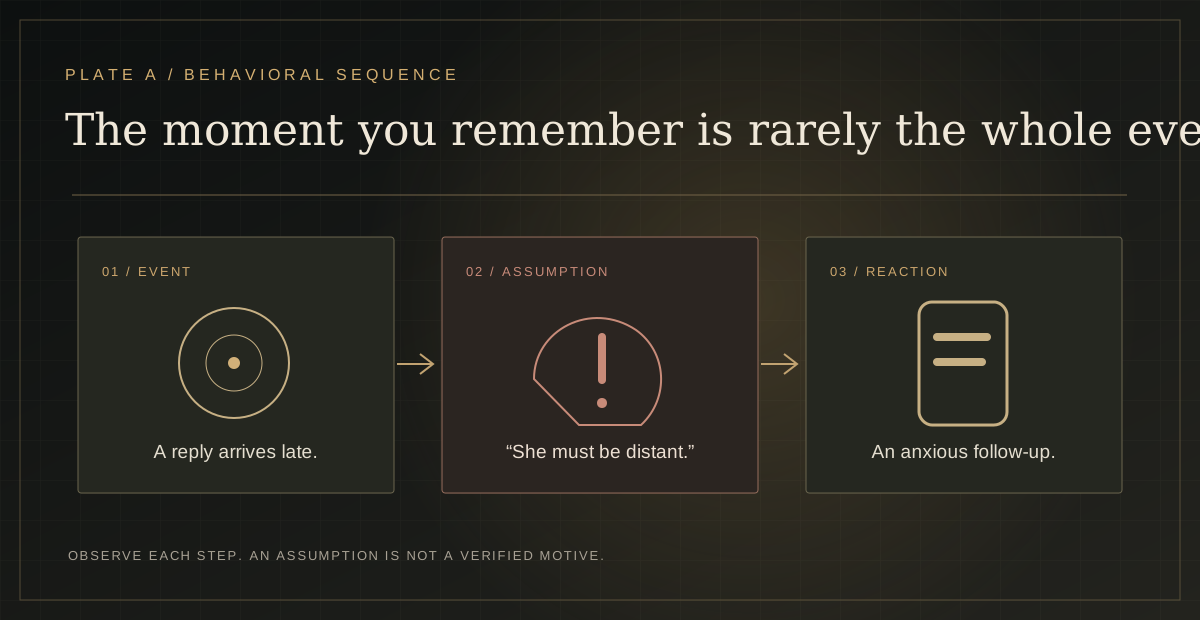
She replies, “I've had a long day.” You interpret it as rejection. You decide she is becoming distant. You begin explaining yourself in response to a motive she has not expressed.
This is the territory explored by Mistake 101 · Wound-Filtered Lens: earlier experiences shaping the way new events are read.
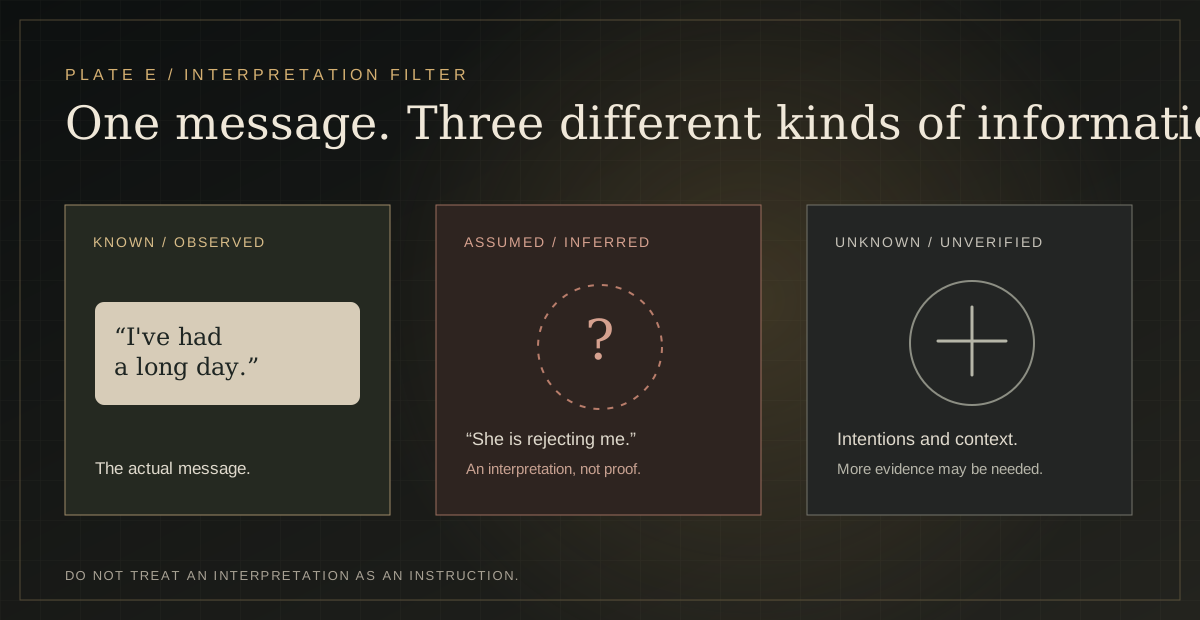
The difference between a fact and an interpretation is operational. 'Her replies are shorter today' is observable. 'She wants me to prove that I care' attributes a motive for which no evidence has yet been provided.
Clarifying questions may help when the subject matters. In other situations the sounder decision is to wait for more information. Reading a new person through an old injury can create unnecessary conflict before either has actually said what they mean.