01 / Journal22 COMPLETE FREE ARTICLES
Start with a question you recognize
Seven illustrated situation guides plus the full searchable collection of field notes and framework explainers.
Browse the JournalFollow the question you have. Find the framework, the field note, the diagnostic or the published book that addresses it.
The Archive maps what has already been published. The 101 Books catalogue is where you compare and purchase the available manuals.
Choose based on what you need right now—not on how familiar you are with the terminology.
Seven illustrated situation guides plus the full searchable collection of field notes and framework explainers.
Browse the JournalThe complete dating-mistakes Atlas, with its field audit, fixed chapter navigation and optional Read Aloud.
Read the complete pillar postRead an illustrated situation, choose a response and reassess when more facts become available.
Open the Case FilesTry the free ten-question Control Scale or inspect the Field Companion included with each manual.
Explore field toolsFind a recurring mistake by topical section (RM-001), or a turning point by relationship stage (RM-002).
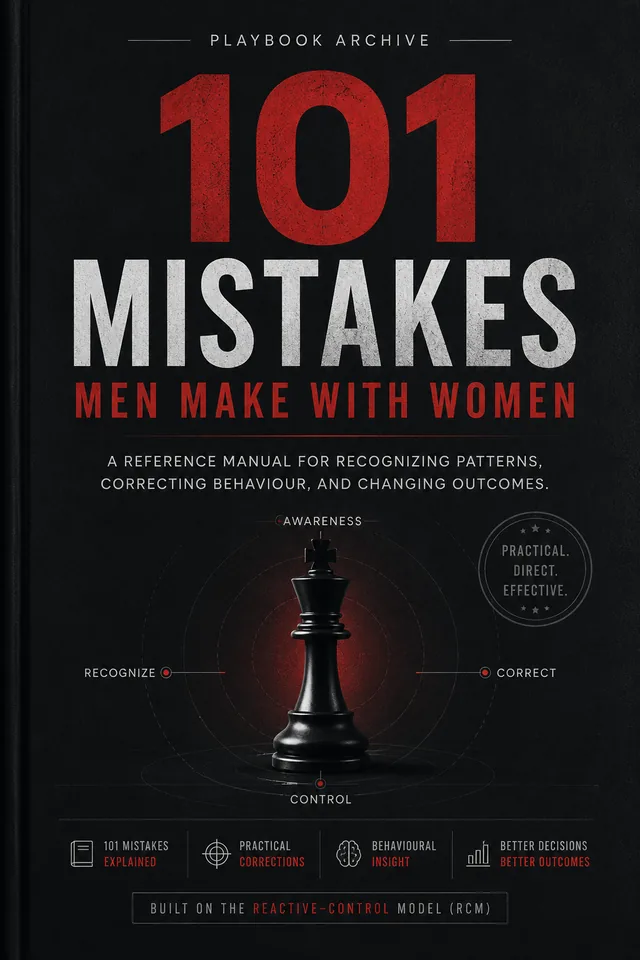
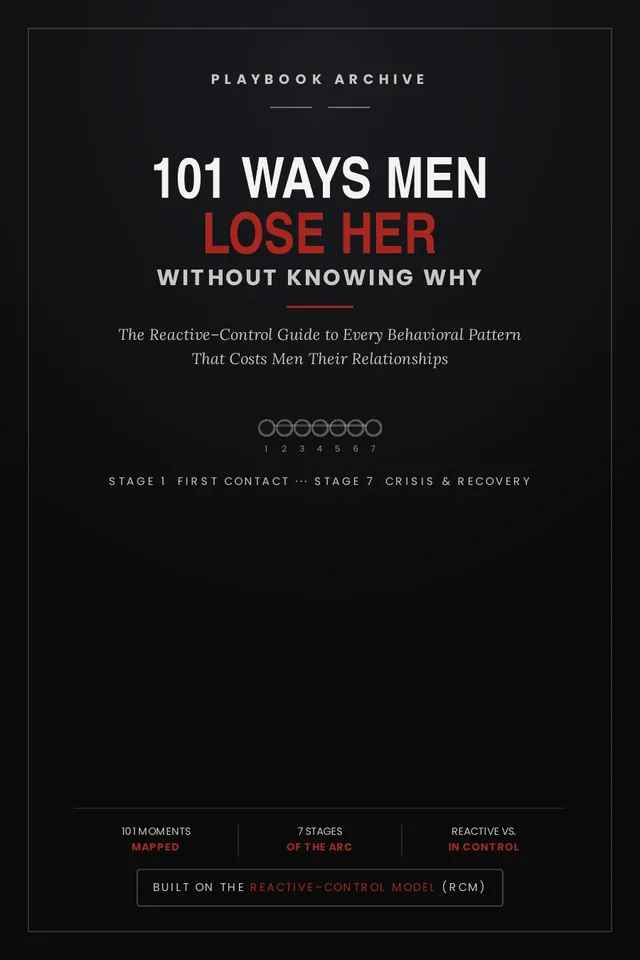
Compare the Two Available BooksTwo operating states, five variables, four failure modes and the current 101 Series decision framework.
Study the RCMSeven situations / Complete free guides
Choose a focused guide, or use the pillar post to see how the patterns connect.
She Takes Hours to Reply: Is She Busy or Losing Interest?
12 min read / Free guideDoes She Like You—or Just Like the Attention?
11 min read / Free guideShe Went Cold After a Great Date. What Actually Happened?
14 min read / Free guide10 Relationship Red Flags Men Ignore Because They're Attracted to Her
13 min read / Free guideHow to Set Boundaries With a Woman Without Damaging the Relationship
13 min read / Free guideWhy Dating Is So Hard for Average Men—and What Actually Helps
12 min read / Free guideWhy Being a Nice Guy Doesn't Automatically Make Her Attracted to You
RCM asks whether a response is governed by external pressure or an internal standard. It does not claim to know another person's motives.
Take the guided first steps →Describe what happened without guessing at motives.
Notice the urge, adjustment or decision that followed.
Read the relevant concept, use a tool or inspect a manual.
These introductory field notes are selected from the existing published Journal. Read one or go straight to the searchable index.
One framework, one variable, every situation. Here's the complete model in one place.
Same message. Same words, even. Two completely different things happening underneath.
Trigger, pause, decision, position held. Skip one step and you get a completely different loop.
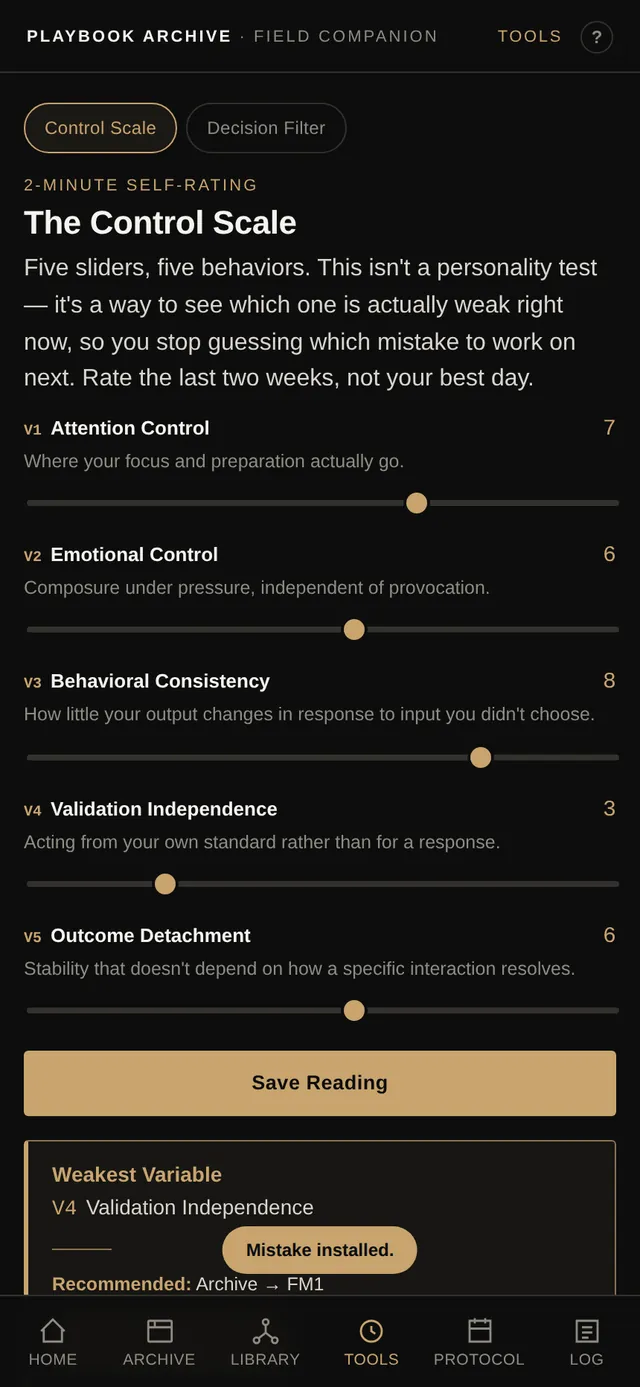 FIELD COMPANION / ACTUAL PRODUCT INTERFACE
The Control Scale is a free, 10-question self-assessment across five control variables. No account is required.
The more extensive Field Companion is included with each published manual; it is not an unrelated subscription.
A framework-based self-assessment, not a clinical test or prediction of relationship outcomes.
Use RM-001 to reference a mistake by category. Use RM-002 to trace a moment by relationship stage. Both are published digital editions with their corresponding Field Companions.
Compare the Two Available Books →RM-001 and RM-002 are available individually or in the verified two-manual bundle. No other title is sold here.
The following concepts are development notes, not release announcements, preorders, or additions to the currently available two-book bundle.
The mechanics of position, pressure, and the variable that often determines whether control holds under stress.
Why it appears. Why it disappears. What you are actually doing when it does.
Recurring relationship and behavioral patterns, mapped and examined through the RCM.
The complete Reactive–Control Model in one volume — all five variables, four failure modes, and the Decision Filter.
A 30-day behavioral tracking protocol for installing the model into consistent daily behavior.
Eighty real scenarios decoded through the RCM — what happened, why, and what the Control Operator does instead.
Three illustrated cases with complete free analysis.