
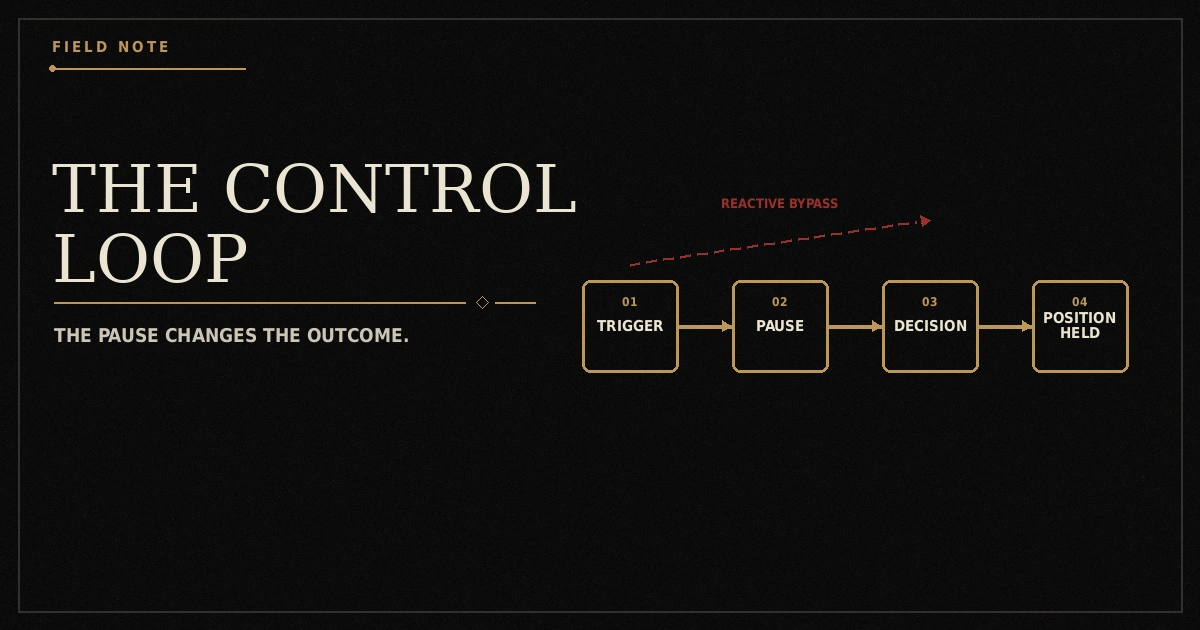
Every reactive habit and every controlled response start at the exact same place: a trigger. What happens in the half-second after that trigger is what the RCM calls the Control Loop, and it’s built around a single, specific insight — the entire difference between reacting and responding is one missing step.
The two loops
Reactive Loop: Trigger \u2192 Emotion \u2192 Adjustment \u2192 Loss of Position.
Control Loop: Trigger \u2192 Pause \u2192 Decision \u2192 Position Held.
Both loops begin identically. A trigger happens — a delayed reply, a change of plans, a comment that lands wrong. What happens next diverges entirely based on one variable: whether a pause gets inserted before the next step, or whether the sequence runs straight through from trigger to emotion to an adjustment in behavior.
Why the pause is the entire mechanism
Emotion, on its own, isn’t the problem the RCM is describing — emotion is going to happen regardless, and trying to suppress it isn’t the goal. The problem is emotion converting directly into behavior without anything in between. The pause is what creates that “in between.” It doesn’t eliminate the emotional response; it just delays the behavioral one long enough for a decision to actually occur, rather than letting the emotion make the decision by default.
This is the mechanical reason Frame Collapse happens as fast as it does — there’s no pause step in the Reactive Loop at all. Trigger goes straight to emotion, which goes straight to an adjustment in position. The entire sequence can complete in under a second, which is exactly why it doesn’t feel like a decision while it’s happening. It isn’t one.
What “position held” actually means
The Control Loop’s final step isn’t “the right outcome” — it’s position held. This distinction matters. The Control Loop doesn’t promise a particular result; it promises that whatever happens next comes from an actual decision rather than from an automatic reaction. Sometimes the decision, after the pause, is to change the original position — that’s still position held, because it was reached deliberately rather than by reflex. The loop is about the mechanism producing the behavior, not about which specific behavior gets produced.
How to actually insert the pause
The Decision Filter is the RCM’s practical tool for this exact step. Its three questions — am I reacting or responding, would I be comfortable if my emotional state were visible, is this serving the connection or my anxiety — are what the pause consists of in practice. Running them isn’t passive waiting for a feeling to subside; it’s an active check that occupies the space where the Reactive Loop would otherwise move straight to an adjustment.
A rough practical minimum: hold for roughly sixty seconds before acting on anything that carries emotional charge. The specific number matters less than the principle — a pause has to exist as a real step, not as an intention that gets skipped under pressure.
Why this is the model’s central diagram
Nearly everything else in the RCM traces back to this loop. Reactive Drift is what happens when the Reactive Loop runs repeatedly without correction. Validation Debt is a specific case where the “adjustment” step is an action taken to produce a reaction. Every failure mode is, structurally, a description of what happens when the pause step goes missing in a particular kind of situation.
See the RCM page for how the Control Loop fits with the five variables and four failure modes it produces or prevents.