
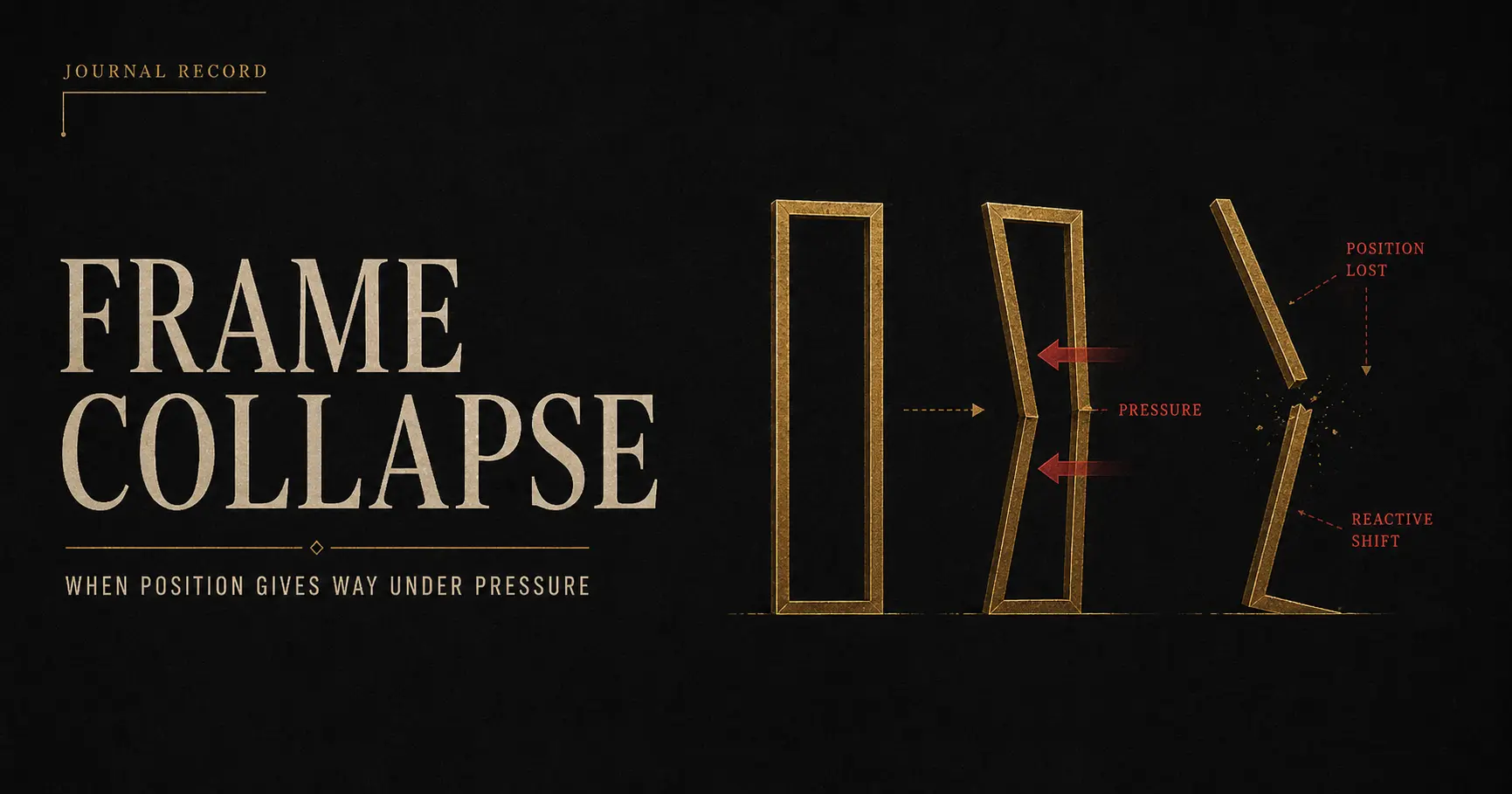
Of the four RCM failure modes, Frame Collapse is the one that happens fastest — often in under a second, in the middle of a conversation, with no visible pause between the trigger and the reaction. That speed is exactly why it’s the hardest one to catch. By the time it’s recognizable, it’s already finished.
What Frame Collapse actually is
Frame Collapse is Failure Mode 2: adjusting position to relieve discomfort under pressure. It traces to Emotional Control (V2) — composure that’s supposed to hold independent of provocation, but doesn’t. The “frame” in question is simply the standard a person is operating from in a given interaction: what’s acceptable, what isn’t, what they’re willing to tolerate. Collapse means that standard bends the instant it meets resistance, rather than holding while the resistance is evaluated.
It’s worth being precise about what this isn’t. It isn’t compromise — compromise is a decision, made deliberately, that both sides can live with. Frame Collapse isn’t a decision at all. It’s a reflex, and reflexes don’t ask whether the new position is actually correct. They just relieve the immediate discomfort as fast as possible.
What it looks like from the inside
The internal experience of Frame Collapse rarely feels like weakness. It feels like being agreeable, flexible, or reasonable — which is precisely what makes it so easy to miss in real time. A plan gets challenged, and the response shifts to accommodate before there’s been any real evaluation of whether the challenge was valid. A joke lands wrong, and the reflexive move is over-explaining or apologizing before there’s time to assess whether an apology was actually warranted. None of this registers as “giving in” while it’s happening. It registers as keeping the peace.
That’s the mechanism worth naming: Frame Collapse doesn’t feel like losing. It feels like being nice. The RCM’s position is that the two are not the same thing, and confusing them is exactly what lets the pattern repeat.
A concrete example
Consider a common version: two people have a plan for the evening. She suggests changing it, without much explanation. The reflexive response is immediate agreement — “sure, no problem, whatever works” — delivered instantly, with no actual thought given to whether the change is preferable or whether the original plan mattered. The speed is the tell. A genuine, considered “actually, I’d rather stick with the original plan, but I’m open to it if there’s a reason” takes a moment to form. An instant, unconditional yes almost always means the standard collapsed on contact, before it was ever evaluated.
The outcome in the moment looks identical either way — the plan changes. What’s different is what happened internally: one is a decision, the other is a reflex that happened to produce a decision-shaped result.
Catching it while it’s happening
Frame Collapse is fast enough that catching it after the fact is mostly useless for the moment itself — by the time it’s recognized, the reaction already occurred. The correction has to happen during the trigger, which is exactly what Decision Filter Q1 is built for: am I about to react, or respond? Asked in the half-second between the trigger and the reflex, this question is often enough to interrupt the automatic sequence, because it forces a moment of attention onto something that was otherwise going to happen entirely below awareness.
The practical version: when a plan, a boundary, or a stated preference gets challenged, and the urge is to immediately concede, that urge itself is the signal to pause — not to hold the position no matter what, but to actually evaluate it before responding, instead of responding on reflex and calling the result a decision.
Why it isn’t about being harder to please
The correction for Frame Collapse is not “disagree more” or “be less accommodating.” That would just be a different reflex replacing the first one. The correction is holding the pause long enough for an actual evaluation to happen — which sometimes concludes that the original position was right, and sometimes concludes that the new one is better. Either outcome is fine. What Frame Collapse removes is the evaluation itself, and that’s the only thing the correction is restoring.
For where Frame Collapse fits among the other three failure modes, see the RCM page. 101 Mistakes Men Make With Women catalogs the specific, recurring situations where this pattern shows up most often.