
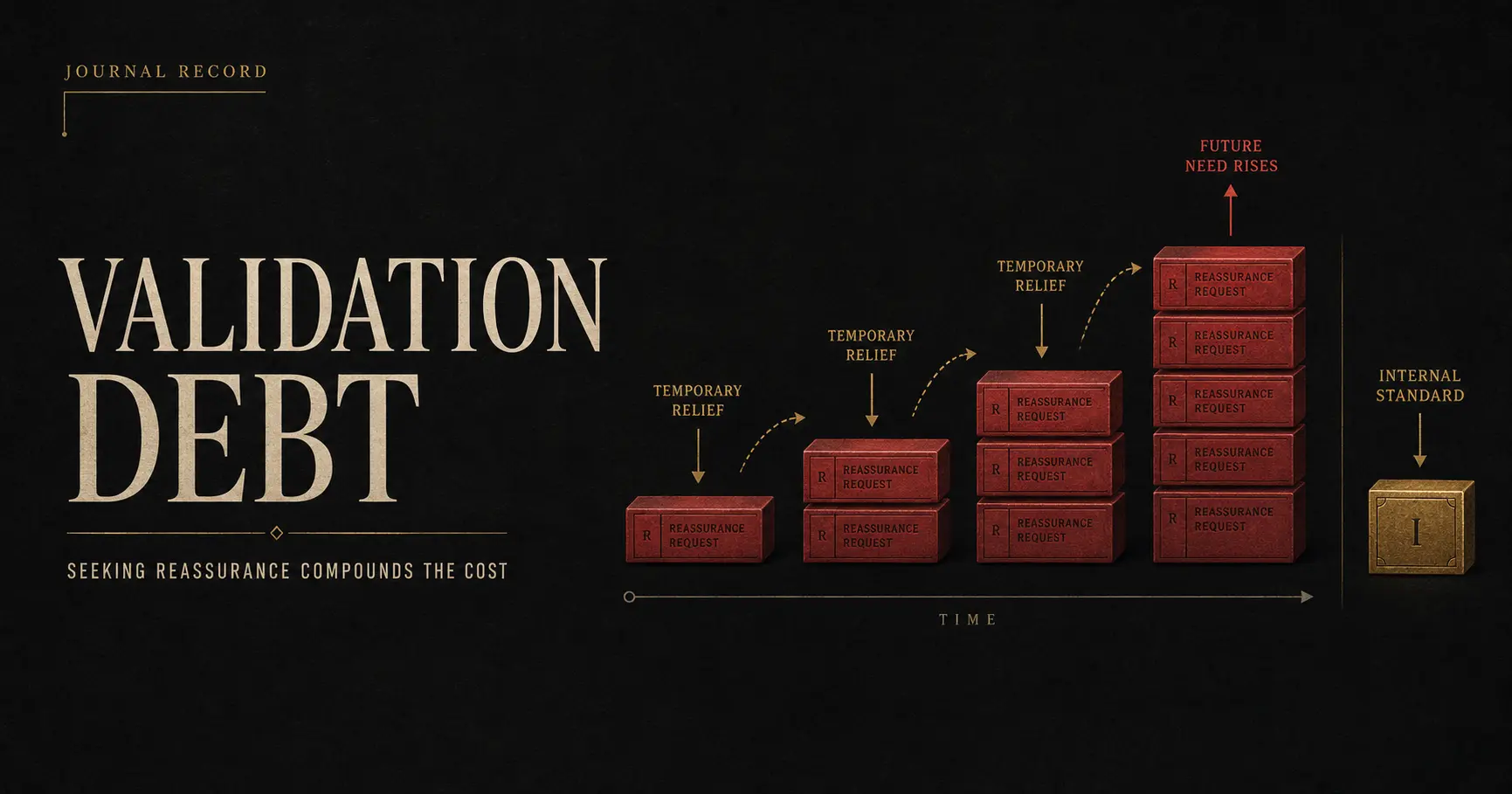
There’s a specific, recognizable pattern where seeking reassurance doesn’t resolve uncertainty — it deepens it. Each request for reassurance works, briefly, and then the underlying uncertainty returns slightly larger than before, requiring a slightly bigger reassurance next time to produce the same relief. The Reactive–Control Model calls this Validation Debt: Failure Mode 1.
What Validation Debt actually is
Validation Debt is what happens when Validation Independence (V4) — acting from an internal standard rather than for a reaction — drops. The defining feature isn’t that reassurance is being sought. Everyone seeks some reassurance sometimes; that’s not the problem the model is describing. The defining feature is that action is being taken specifically in order to produce a reaction — a reply, an expression of approval, a sign that everything’s fine — rather than as an expression of a standing decision that would exist regardless of what reaction it produced.
The “debt” framing is deliberate. Each validation-seeking action creates a short-term relief and a longer-term cost: it teaches the part of the mind driving the behavior that uncertainty gets resolved by seeking external confirmation, rather than by tolerating the uncertainty until it resolves on its own. That lesson compounds. The next uncertainty gets met with the same strategy, faster and with less deliberation than the last time — the same way debt compounds when only the interest gets paid.
What it looks like
Validation Debt rarely looks like a single obvious act. It looks like a pattern of small ones: rereading a sent message to check the tone landed correctly. Asking a question whose real function is confirming the relationship is fine, phrased as something else. Needing an explanation for a delayed reply before the anxiety about it will settle. None of these are inherently wrong in isolation — the tell is the function. Is the action expressing something that was already true regardless of outcome, or is its entire purpose to generate a specific reassuring response?
A useful internal test: would this same action still happen if there were no way to know how she’d respond to it — no read receipts, no reply at all, ever? If the honest answer is no, the action was never really about what it appeared to be about. It was about resolving the discomfort of not knowing.
Why paying it down with more validation doesn’t work
The intuitive fix — get the reassurance, feel better, move on — is exactly what keeps the debt growing. Each successful validation-seeking action confirms, to whatever part of the mind is running the pattern, that this is a reliable way to resolve discomfort. That confirmation makes the next instance of discomfort more likely to trigger the same response, not less. The debt isn’t paid down by more of the thing that created it. It’s paid down by withholding the action and tolerating the discomfort until it passes on its own — which it reliably does, given enough repetitions of not feeding it.
This is the specific correction listed in the RCM’s Failure Mode Quick Guide for FM1: run Decision Filter Q3 — “is this action serving the connection, or my anxiety?” — and if the honest answer is anxiety, withhold the action. Each withheld action is what actually reduces the debt, not each satisfied one.
The difference between this and just “not caring”
It’s worth being precise here, because the correction is easy to misread as an instruction to stop caring about the relationship, which isn’t what it is. Outcome Detachment (V5) — the variable most people associate with “not caring” — is about stability that doesn’t depend on any single interaction’s result. Validation Independence is narrower: it’s specifically about where the motivation for an action originates. A man can care deeply about a relationship and still act from a standard rather than for a reaction — in fact, the model’s position is that this is what caring from a stable position actually looks like, as opposed to caring in a way that requires constant external confirmation to feel real.
For where Validation Debt fits among the RCM’s other three failure modes, see the RCM page. The Field Companion’s Control Scale includes Validation Independence as one of the five variables it tracks over time, rather than as a single one-time assessment.