
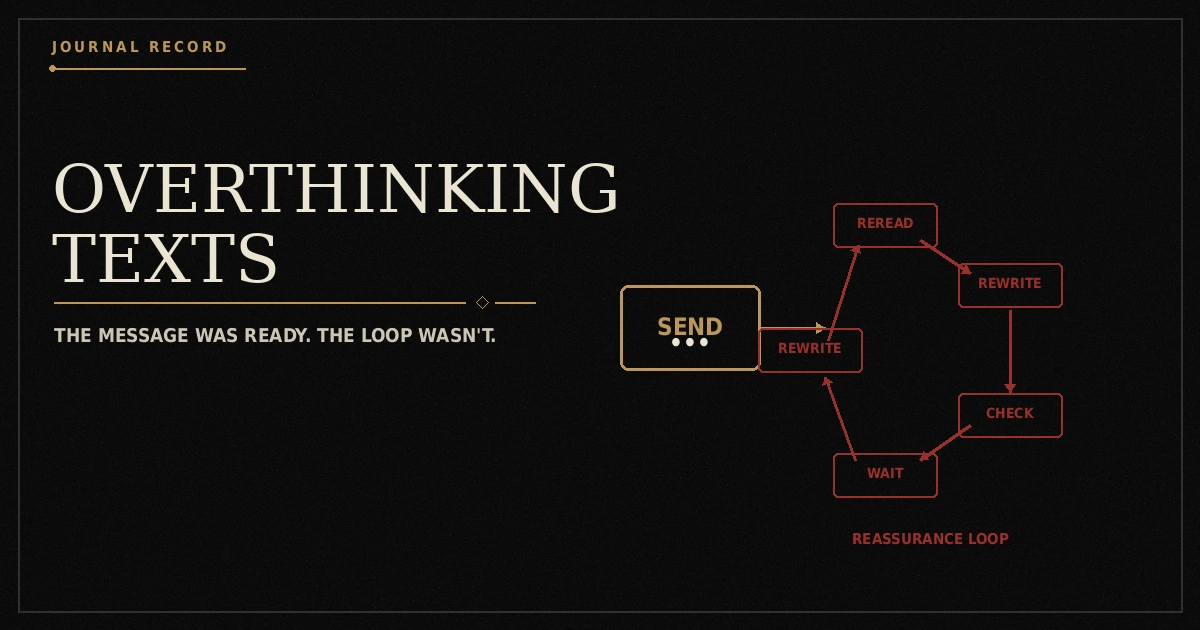
Overthinking a text message — writing it, deleting it, rewriting it, reading it eleven times before sending — is common enough to feel like its own category of behavior. In the RCM, it isn’t a separate thing. It’s a specific, recognizable expression of Validation Debt, applied to the writing process instead of to waiting for a reply.
What’s actually happening during the eleventh reread
By the second or third read-through, most messages already say what they’re meant to say. What continues after that point usually isn’t editing for accuracy — it’s an attempt to control something that can’t actually be controlled: how the message will be received on the other end. Each additional reread is, functionally, an attempt to eliminate the uncertainty of how it’ll land, which is exactly the mechanism behind Validation Debt — taking action (in this case, revising) to manage an anxious feeling rather than because the action itself is still needed.
This is worth being precise about, because it doesn’t feel like anxiety while it’s happening. It feels like care — like being thoughtful, making sure the tone is right, avoiding a misunderstanding. Sometimes that’s genuinely what’s happening. The tell is whether the revisions are changing anything real, or whether the message has stopped changing and the rereading is continuing anyway.
Why more editing usually doesn’t help
There’s a specific irony here: messages that get overthought the most often read worse, not better, than ones written once and sent. Anxiety has a way of showing up in the final wording regardless of how many times it’s revised — extra qualifiers, over-explanation, a tone that reads as tentative because it was written by someone in a tentative state. The overthinking doesn’t hide the underlying discomfort. It often just adds more words for the discomfort to show up in.
The practical fix
Run Decision Filter Q3 at the moment of reaching for another reread: is this serving the message’s actual content, or is it serving the anxiety about how it’ll be received? If nothing factually needs to change and the honest answer is the second one, that’s the signal to send the message as it currently stands. The urge to reread again is the same category of urge the Decision Filter is built to interrupt everywhere else — it just shows up here as editing instead of as sending a follow-up.
A useful practical rule: two read-throughs for actual accuracy — does it say what’s meant, is anything unclear or likely to be misread — and then send. Anything past that is worth treating as a reactive loop rather than as genuine editing, and running the Control Loop — trigger, pause, decision, position held — against the urge to reopen and reread again.
Why this matters beyond just texting
The specific behavior — overthinking a message — is small. The underlying pattern isn’t: it’s the same Validation Debt mechanism that shows up in checking read receipts, needing an explanation for a delayed reply, or rereading a sent message to check the tone landed correctly. Recognizing it in the writing stage, before the message is even sent, is often the earliest point the pattern can be caught — well before it escalates into checking and rechecking after the fact.
See Validation Debt for the full mechanism this pattern traces to, or the RCM page for the complete framework.