
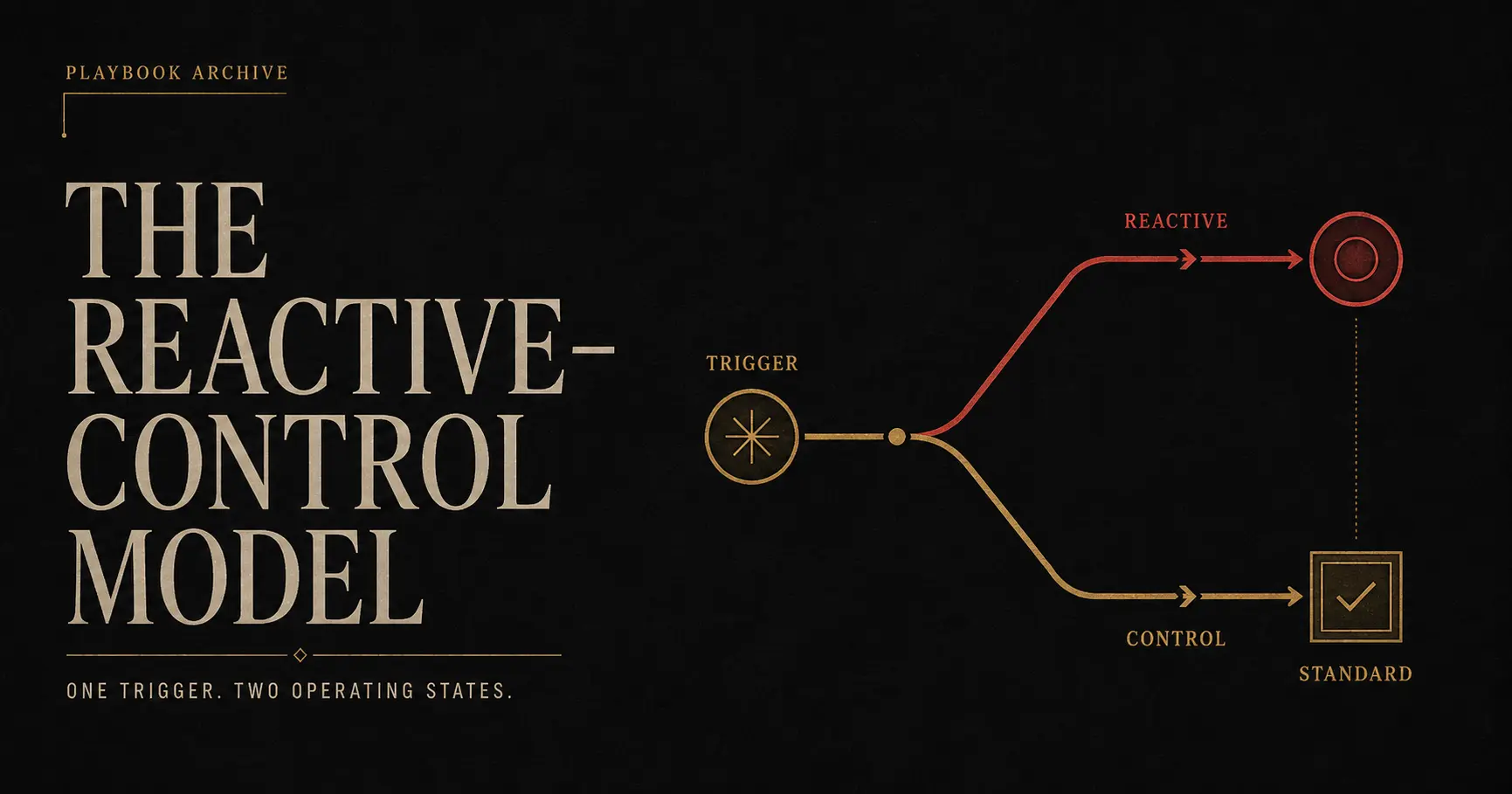
Most advice about attraction and relationships operates on the same layer: here’s what to say, here’s what to do, here’s the script. The Reactive–Control Model (RCM) operates one layer down. It isn’t a script. It’s a diagnostic framework for a single question: in this moment, is his behavior being driven by her, or by his own standard?
That question is the entire model. Everything else is detail.
The core claim
You don’t lose because of her behavior. You lose because of your reaction to it.
This is not a claim that her behavior doesn’t matter. It’s a claim about where the leverage is. Her behavior is not something he controls. His reaction to it is the only variable he actually has authority over — and, according to the model, it’s also the variable that determines the outcome more often than the triggering behavior itself.
That reframes the entire problem. Instead of asking “what should I do when she pulls away,” the question becomes “what is my behavior being driven by right now — her pulling away, or my own standard?” Those are different questions with different answers, and only one of them is inside his control.
The two states
The RCM defines exactly two operating states.
Reactive State. Behavior is driven by external stimulus. Her mood, her response time, her warmth or distance functions as an input that directly produces an output in his behavior. He adjusts to restore comfort. He seeks confirmation before acting. Investment rises and falls with her signals rather than holding steady.
Control State. Behavior is driven by an internally defined standard. The external environment still exists and still gets read — but it’s read as information, not instruction. Position holds under pressure. Action comes from an honest assessment of what he wants to do, not from a need to produce a particular reaction in her.
The core law of the model: the moment you react, you transfer control. Not metaphorically — mechanically. Reacting means letting an external event set the terms of the next move. Whoever’s behavior is setting the terms is, structurally, the one in control of the interaction.
The five control variables
Five internal variables determine which state he’s actually operating in at a given moment. They’re independent — a man can be strong on one and weak on another simultaneously.
- V1 — Attention Control. Where focus and preparation actually go, versus where it’s supposed to go.
- V2 — Emotional Control. Composure under pressure, independent of provocation.
- V3 — Behavioral Consistency. How little the standard changes in response to input he didn’t choose.
- V4 — Validation Independence. Acting from his own standard rather than for a reaction.
- V5 — Outcome Detachment. Stability that doesn’t depend on how any one interaction resolves.
Each variable can be scored independently on the Control Scale, which is exactly why the model treats them as five separate diagnoses rather than one vague “confidence” score.
The four failure modes
When a variable drops, it doesn’t fail silently — it produces a specific, recognizable pattern. The RCM names four:
- FM1 — Validation Debt. Acting for a reaction rather than from a standard.
- FM2 — Frame Collapse. Adjusting position to relieve discomfort under pressure.
- FM3 — Reactive Drift. The behavioral floor sliding to track whatever is happening around him.
- FM4 — Perceived Value Drop. Over-investing or under-preparing in a way that flattens attraction.
Naming the failure mode matters because it points directly at the correction. “Be more confident” is not actionable. “Run Decision Filter Q1 before responding, because this is Frame Collapse” is.
Why a model instead of advice
Generic advice describes what happened after the fact: she lost interest, he came on too strong, the conversation died. The RCM is built to sit one level underneath that description — not what happened, but the mechanism that produced it. Two men can make the same outward mistake for two different underlying reasons, which means the same generic tip fixes one of them and does nothing for the other. Diagnosing the variable and failure mode first is what makes the correction actually fit the person it’s for.
This is also why the archive is structured the way it is. 101 Mistakes Men Make With Women applies the model as a flat reference — 101 specific mistakes, each tagged to its failure mode and variable. 101 Ways Men Lose Her Without Knowing Why applies the same model across a relationship’s actual seven-stage timeline. Different structure, same underlying framework.
Where to go from here
If you’re new to the model, the RCM page has the complete framework in one place — the two states, all five variables, all four failure modes, the Decision Filter, and the Control Scale for self-assessment. The Field Companion turns the self-assessment into something you can actually track over time rather than re-read.