
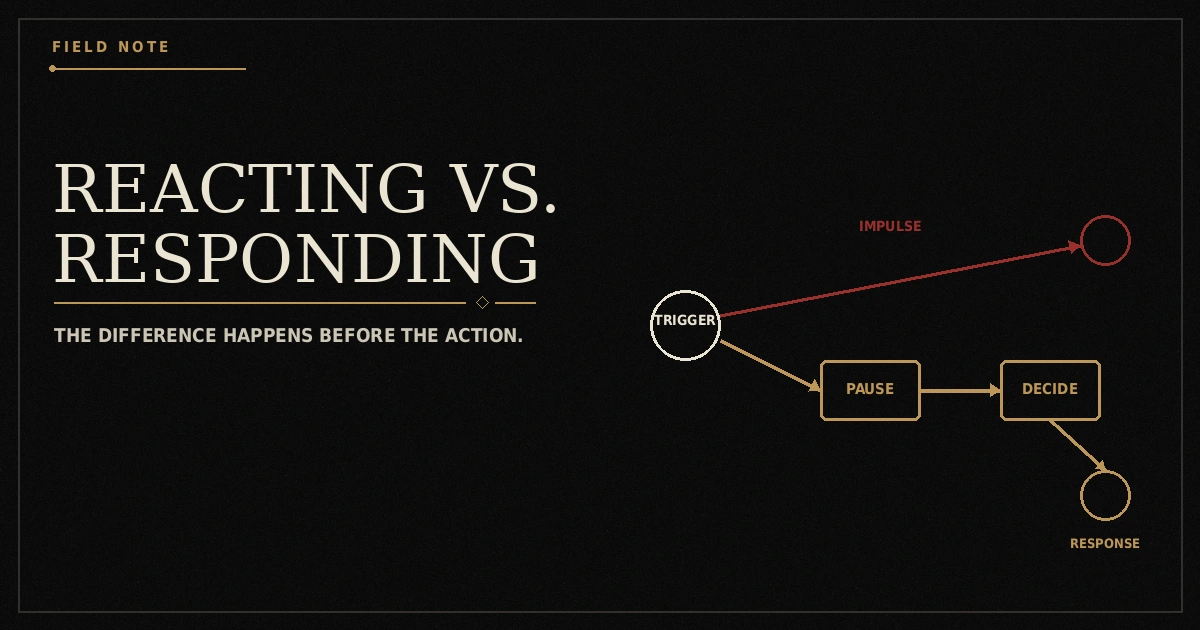
Reacting and responding can look completely identical from the outside — the same words, the same tone, the same decision to send a message or hold back. The entire Reactive–Control Model rests on a claim that this outward similarity is misleading: what matters is not the action, but what produced it.
The definitions
Reacting is behavior driven by discomfort. Something happens, an uncomfortable feeling shows up, and the behavior that follows exists to relieve that feeling as quickly as possible. The behavior is, functionally, in service of the discomfort — whether or not it looks that way from the outside.
Responding is behavior driven by a decision. The decision may have been made moments ago or weeks ago; what matters is that it existed independent of this specific triggering moment. The behavior expresses something already decided, rather than being manufactured on the spot to resolve a feeling.
Why the same action can be either one
This is the part that makes the distinction genuinely useful rather than just semantically tidy. Consider sending a text that says “hey, thinking of you.” As a response, this expresses a standing decision — he wanted to say it, and would have said it regardless of the last message received. As a reaction, the identical text is functioning to resolve the discomfort of not having heard back, dressed in affectionate language. Read from the outside, with no access to what was happening internally, the two are indistinguishable. That’s exactly the problem: judging behavior by its content alone misses which of the two actually occurred.
Why this is harder to catch than it sounds
Reactions rarely announce themselves. The internal experience of a reactive action is usually not “I am reacting” — it’s “this seems like a reasonable, appropriate thing to do right now.” That’s precisely what makes Frame Collapse and Validation Debt so persistent: they don’t feel like malfunctions while they’re happening. They feel like ordinary, sensible behavior.
The practical test
The Decision Filter’s first question exists specifically to expose this: am I about to react, or respond? Asking it requires a genuine pause — not rhetorical, an actual moment spent checking whether the impulse traces back to a standing decision or to the discomfort of this exact moment. If it traces to the discomfort, the Control Loop says: stop, hold, and let a real decision form before acting.
Why the distinction is the whole model, not just one part of it
Nearly every other RCM concept is a variation on this same check, applied to a specific situation. Reactive Drift is what happens when small reactions accumulate without ever being caught by this test. Perceived Value Drop is what a pattern of reacting, rather than responding, does to how investment reads externally over time. The five variables and four failure modes are, underneath the specific names, different lenses on the same underlying question: right now, in this exact moment, is the behavior coming from discomfort or from a decision?
For the complete framework this distinction sits at the center of, see the RCM page.