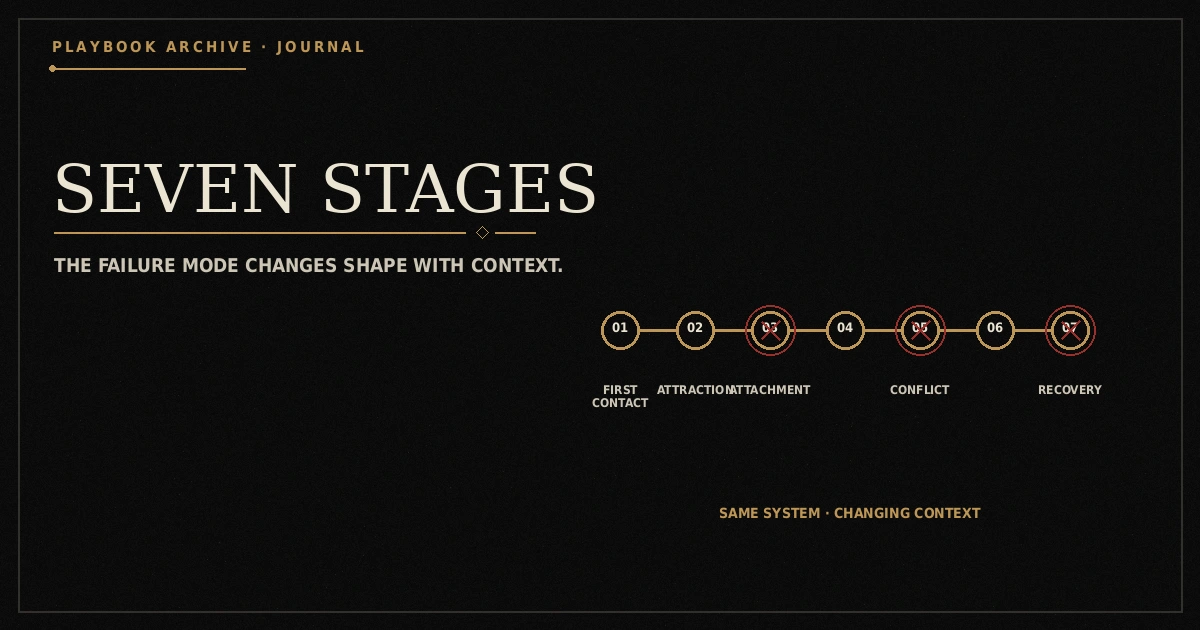
Most behavioral advice treats a relationship as a single undifferentiated thing — the same mistakes, the same fixes, regardless of when they happen. The RCM’s application model for relationships takes a different approach: it maps a relationship’s actual timeline across seven stages, because the same underlying failure mode produces very different visible behavior — and carries very different stakes — depending on where in that timeline it shows up.
The seven stages
1. First Contact. The earliest signals — initial attraction, first impressions, the first few exchanges. Frame Collapse here often looks like abandoning a plan or a stated interest at the first sign of any resistance.
2. Early Dating. The relationship is being actively evaluated by both sides. Perceived Value Drop is especially visible in this stage — investment that outpaces what’s being reciprocated reads clearly here, before other context has built up to complicate the read.
3. The Pull-Back. A stage marked by distance or reduced engagement, for reasons that may or may not be visible. This is the stage where Validation Debt shows up most acutely — the uncertainty is exactly the kind of discomfort that drives reassurance-seeking.
4. Commitment Formation. The relationship is moving toward something more defined. Reactive Drift often starts quietly here, as early standards begin flexing “just this once” in the name of building something together.
5. Shared Territory. Life has genuinely intertwined — routines, social circles, shared logistics. Failure modes here tend to be less dramatic and more cumulative, which makes them easier to miss.
6. Long-Term Pressure. Sustained stress — external or internal — tests whatever standards have held up to this point. This is where Behavioral Consistency (V3) gets its hardest test, since the pressure is no longer a single triggering moment but an ongoing condition.
7. Crisis and Recovery. Acute conflict or rupture, and what happens afterward. Every failure mode can appear here in concentrated form, and the stakes of getting the response right — rather than reacting — are at their highest.
Why the stage changes what the same mistake looks like
Consider Frame Collapse specifically. During First Contact, it might mean instantly agreeing to change plans the moment there’s the mildest pushback — low stakes, easy to miss, easy to recover from. During Long-Term Pressure, the identical mechanism — position collapsing under discomfort — might mean conceding a boundary that had genuinely held for years. Same underlying failure mode, wildly different consequences, because the stage changes what’s actually at stake when the collapse happens.
This is the core argument for why a purely categorical approach (organizing mistakes by type, with no reference to timeline) misses something a timeline-based approach catches: when something happens changes what it means, even when what happens is identical.
Why this matters for diagnosis
Knowing which stage a relationship is in narrows down which failure modes are statistically more likely to be active, which makes diagnosis faster. A pattern of anxious, reassurance-seeking messages during The Pull-Back stage is very likely Validation Debt; the same pattern during Shared Territory might instead point at Reactive Drift that’s been building for a while. Same visible behavior, different likely cause, because the stage provides context the behavior alone doesn’t.
Where this framework is fully mapped
101 Ways Men Lose Her Without Knowing Why is built entirely around this seven-stage structure — 101 specific moments, organized by where they occur in the timeline rather than by category. See the RCM page for how the seven-stage application model relates to the core framework underneath it.