
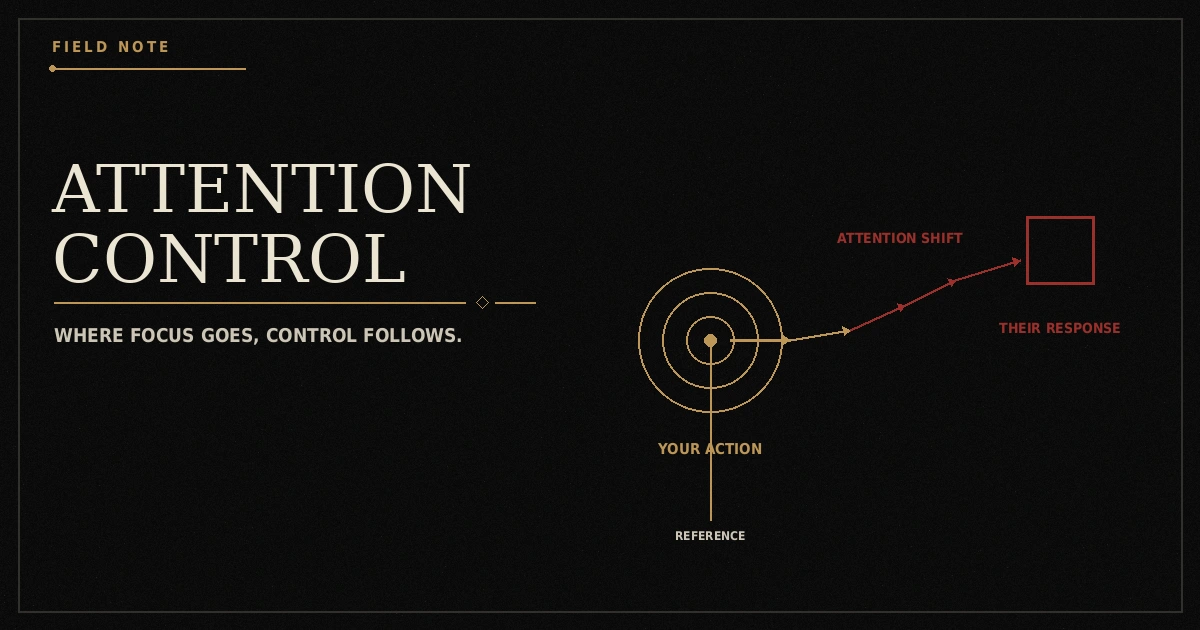
Attention Control is the first of the RCM’s five control variables: where focus and preparation actually go, as opposed to where they’re supposed to go. It’s the variable most directly observable from the outside, because attention shows up as behavior — what gets checked, how often, and what doesn’t get done because of it.
What it actually measures
Attention Control isn’t a measure of interest. Interest is internal and largely invisible; Attention Control is about what the interest does to observable behavior. Two men can be equally interested in the same person and score completely differently on this variable — one keeps functioning at work, keeps his other commitments, and checks his phone on a normal schedule; the other refreshes a conversation thread every few minutes and reads results into details that don’t have one.
The RCM’s specific framing: in the Reactive State, attention migrates to monitoring — posts, reply speed, tonal shifts in a message — rather than staying on his own life and work. In the Control State, attention stays selective and intentional, directed at what he’s actually chosen to prioritize.
Why it drops without anyone noticing
Attention doesn’t announce when it’s been captured. A single check of a phone doesn’t feel like anything has changed. It’s the accumulation — the fifth check in an hour, the mental space a delayed reply occupies during an unrelated meeting — that constitutes the actual shift, and accumulation is exactly the kind of change that’s hard to notice from inside it. This is the same mechanism behind Reactive Drift, applied specifically to where focus goes rather than to a behavioral standard more broadly.
A concrete test
A useful, specific check: over the last 24 hours, how many times was a phone checked specifically because of one person, versus for any other reason? Most people significantly undercount this from memory — it doesn’t register as a pattern because each instance felt small and justified on its own. Counting it directly, even roughly, is often the first moment the actual scale of the migration becomes visible.
The correction isn’t “care less”
The instinct is to treat weak Attention Control as a caring problem — the fix being to care less so there’s less pulling focus away. That’s not what the RCM’s correction is. The fix is redirection: when the pull to check shows up, the response is returning attention to whatever was the actual priority before the pull happened, not suppressing the interest itself. Over enough repetitions, this changes where attention defaults to — not by force, but because redirected attention is what a standard actually looks like in practice, rather than as an abstract idea.
How this interacts with the other variables
Attention Control is one of two variables behind Perceived Value Drop (FM4) — attention that’s disproportionately absorbed is itself part of what reads, externally, as over-investment. It’s also frequently the earliest visible sign that Reactive Drift has started, since a shifting standard usually shows up in where attention goes before it shows up anywhere else.
The Control Scale scores V1 independently from the other four variables for this reason — it’s diagnosable on its own, and the correction for it doesn’t require fixing anything else first.