
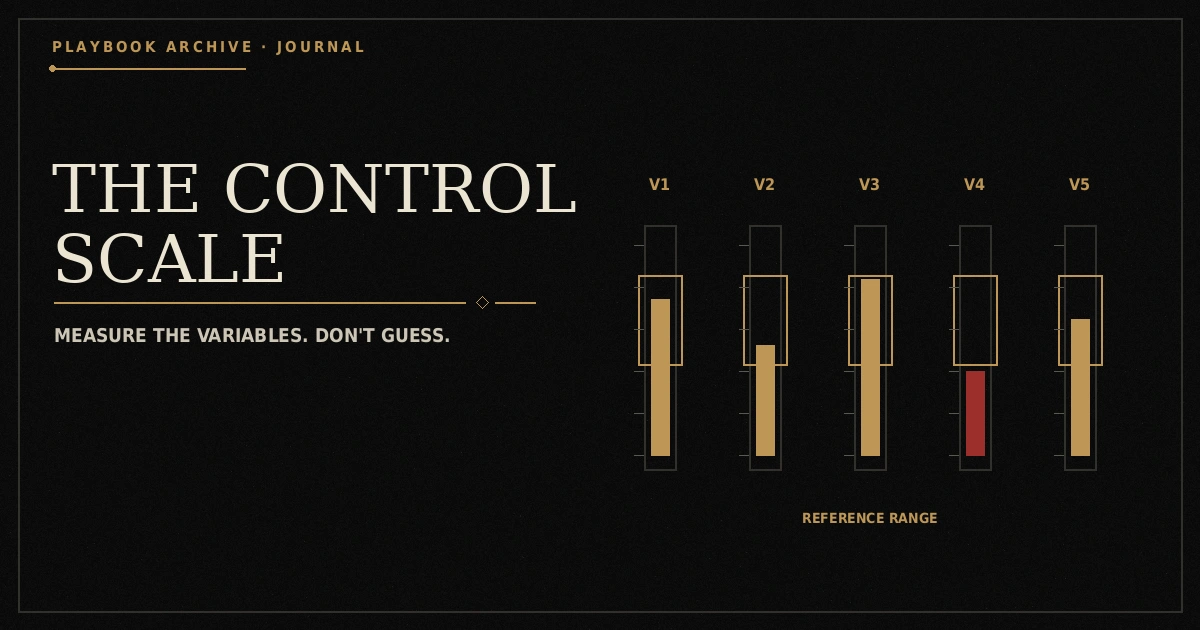
The Control Scale is the RCM’s answer to a specific problem: “be more in control” is not a usable instruction, because it doesn’t say which variable needs work. The Control Scale fixes this by scoring each of the five control variables separately, 1 to 10, rather than producing one vague overall impression.
The four bands
1–3 — Fully Reactive. Behavior is driven almost entirely by external stimulus. Every variable, if scored honestly, reads low at this stage.
4–6 — Aware but Unstable. The pattern is visible after the fact — recognition exists — but the correction doesn’t yet fire in the moment itself. This is where most people who’ve started paying attention to their own patterns actually sit.
7–8 — Controlled. The standard holds under ordinary pressure. When there’s a lapse, recovery is fast rather than becoming a new baseline.
9–10 — Strategic. Position holds even under sustained pressure. At this stage the variable isn’t something actively managed anymore — it’s simply how the person operates by default.
Why five separate scores, not one
A single composite score would average away exactly the information that makes the scale useful. Someone can hold a 9 on Behavioral Consistency (V3) — an unshakeable standard — while sitting at a 3 on Attention Control (V1), checking a phone compulsively despite otherwise never wavering on stated boundaries. Averaged together, that’s a 6 — “aware but unstable,” which describes neither variable accurately and points at no useful correction. Scored separately, it’s obvious exactly where the work needs to go.
How to score honestly
The main obstacle to an accurate Control Scale score isn’t lack of self-awareness — it’s the temptation to score based on values rather than on the last week’s actual behavior. Someone can genuinely believe they operate from Validation Independence and still, on an honest review of the last seven days, find several actions that were clearly taken to produce a reaction rather than from a standing decision. The useful version of this exercise looks backward at specific, recent, real instances — not at a general self-concept.
A practical method: for each variable, recall the three most recent moments that variable was actually tested — not hypothetical situations, but real ones from the last week or two — and score based on what happened in those specific instances, not on how the person would like to have behaved.
What to do with the lowest score
The Control Scale’s practical output is simple: whichever variable scores lowest is the entry point. That’s the failure mode most actively producing lost position right now, and it’s the one worth working on before the others — not because the other variables don’t matter, but because effort spread across all five at once tends to produce less change than concentrated effort on the one that’s actually failing.
Re-scoring over time
A score taken once and never revisited misses the thing Reactive Drift specifically describes: standards move gradually, and a variable that scored a 7 two months ago may have quietly slid to a 4 without ever feeling like a single dramatic change. Re-scoring periodically — not constantly, but on a regular check-in cadence — is what catches that slide early enough to correct it.
The Field Companion includes a live version of the Control Scale built for exactly this kind of periodic re-scoring, rather than a one-time assessment that goes stale.