
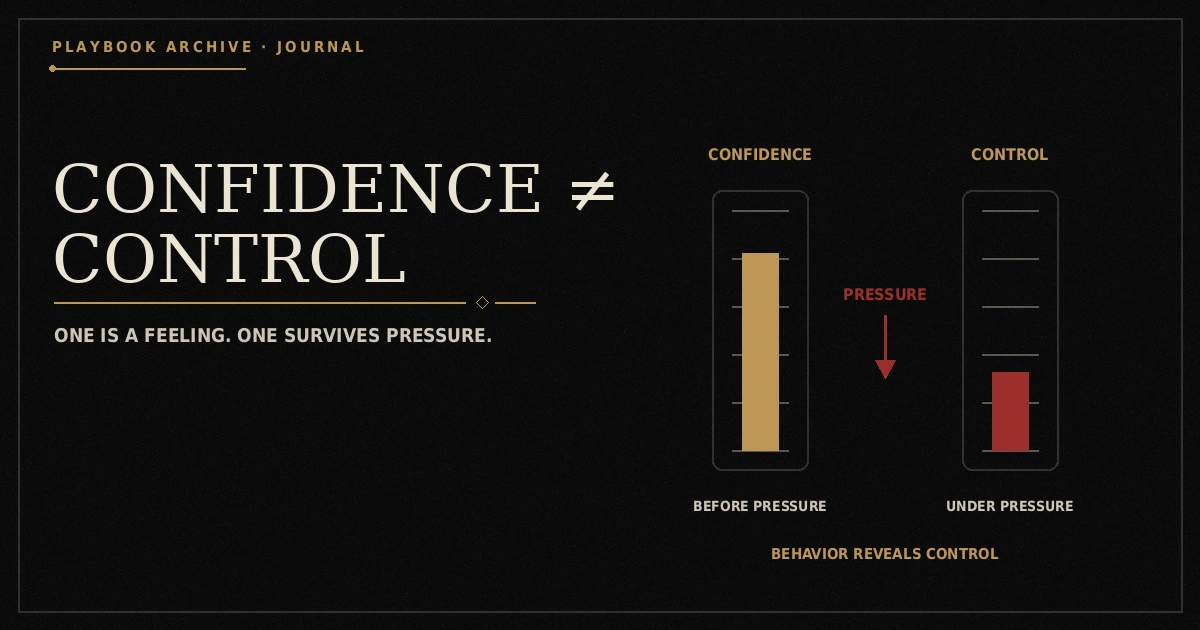
Confidence and control get used almost interchangeably in most advice about attraction and relationships — “be more confident” is offered as though it’s the same instruction as “hold your position under pressure.” In the Reactive–Control Model, they’re treated as genuinely different things, and the difference matters more than it might first appear.
What each one actually is
Confidence is an internal feeling — a sense of self-assurance, of being generally okay with oneself and one’s position. It’s real, it matters, and it’s also not directly observable from the outside; it can only be inferred from behavior, which is exactly where the trouble starts.
Control, in the RCM’s specific sense, is a pattern of behavior: does the standard hold when it’s tested? It’s directly observable — anyone can watch what happens when a plan gets challenged or a message goes unanswered and see, from the actual response, whether position held or collapsed. It doesn’t require access to anyone’s internal state to assess.
Why they can diverge
A person can feel entirely confident — generally self-assured, not anxious in any global sense — and still experience Frame Collapse the instant a specific plan gets challenged. Confidence as a general disposition doesn’t automatically produce a pause before a specific reactive impulse; the two operate somewhat independently. This is why “just be more confident” so often fails as practical advice — it’s frequently true already, and the specific behavioral pattern causing the visible problem is untouched by it.
The reverse also holds, and the RCM treats this direction as the more useful one: a person can feel genuinely uncertain in a given moment — not sure how something will land, not free of doubt — and still hold a controlled, deliberate response. The feeling of uncertainty and the behavior of holding position aren’t mutually exclusive. Control doesn’t require the absence of doubt. It requires that the doubt doesn’t get to make the decision.
Why the RCM corrects behavior, not feelings
This is a deliberate design choice in the model, not an oversight. Feelings are real and matter, but they’re difficult to address directly, and — as the divergence above shows — they don’t reliably predict behavior under pressure anyway. The five control variables and four failure modes all describe observable behavior: where attention goes, whether position holds, whether an action was taken from a standard or to produce a reaction. None of them ask how someone feels going in, because the feeling isn’t what’s actually producing the outcome. The behavior under pressure is.
A practical implication
If a specific behavioral pattern — say, over-texting, or conceding plans instantly under any resistance — keeps recurring despite a person generally feeling self-assured in most areas of life, the useful move isn’t to work harder on confidence in the abstract. It’s to run the Control Scale against the specific variable involved and diagnose the actual mechanism — which is very often a distinct, addressable pattern that a general sense of confidence doesn’t automatically fix.
Where this fits in the framework
Confidence isn’t a variable the RCM tracks at all — deliberately. See the RCM page for the five variables it does track, all of them behavioral rather than emotional, and all of them scoreable independent of how confident someone happens to feel on a given day.