APPROACH & PRESENCE12-MIN FIELD GUIDE4-STAGE CASE INVESTIGATION
FIELD STUDYBEFORE THE WORDS.
In this Atlas 13 sections
READ ALOUDReady to listen
Uses your browser’s available voice.
01 / THE OVERLOOKED DECISION
He spent two minutes preparing an introduction. He spent almost no time examining the situation.
At a gallery opening, a man notices a woman near an installation. She is speaking with a friend. He finds her attractive, thinks about what to say, rejects one opening, and rehearses another.
Then he decides to stop overthinking. He approaches from behind, steps beside her, and starts speaking. She turns, visibly surprised. He talks faster to recover. When she looks toward her friend, he asks another question. She says she needs to rejoin the group; he lingers anyway.
Later he replays his words: Maybe the introduction was weak. Maybe the joke was awkward. Maybe I should have been more confident.
THE MISDIAGNOSISHe remembers his opening line. He barely remembers the decisions around it.
The problem might have begun before he spoke: when he approached, where he stood, whether he interrupted, and whether he noticed the conversation ending.
101 Mistakes Men Make With Women examines 24 mistakes across its Body Language & Presence and Approach & Timing sections. This Atlas uses one social encounter to show how several distinct errors can accumulate. The aim is not guaranteed attraction; it is better judgment based on observable behavior.
02 / INTERACTIVE CASE INVESTIGATION
One introduction. Four decisions.
Follow the encounter from the initial opportunity to the final departure. Each stage contains a different question. This is the diagnostic spine of the article—not a formula for getting someone to like you.
CASE FILE / GALLERY OPENINGFOUR-STAGE INVESTIGATION
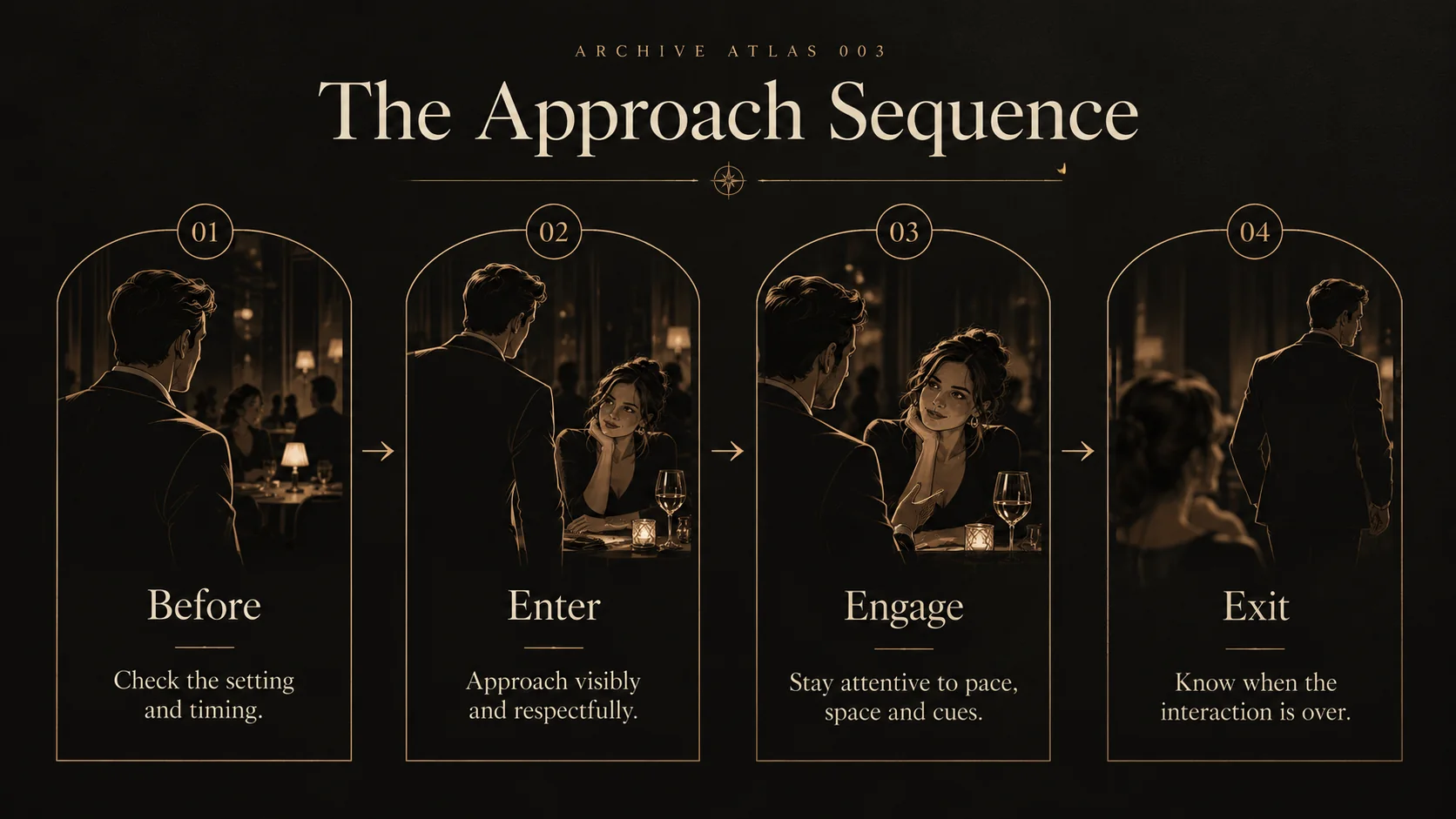
BEFORE / CONTEXT
Was there actually an opening?
She is already speaking with a friend. His urgency to introduce himself does not create permission to interrupt their conversation.
OBSERVE
An existing conversation is underway.
BETTER DECISION
Wait for a suitable opportunity, or don't approach.
REFERENCE
Mistake 39 · Logistical Blind Spot
Visual field map: Before → Enter → Engage → Exit. Use the investigation above for the full readable explanation.03 / BEFORE — MISTAKES 39, 40, 47
The opportunity you thought you saw.
Imagine a woman hurrying toward a train platform, checking the departure board with headphones on. Now picture a visitor at an informal gallery opening where introductions are common. Your interest might be the same. The practical circumstances are not.
The manual calls failure to consider logistics Logistical Blind Spot (Mistake 39). A related mistake, Context Misread (Mistake 40), occurs when your behavior does not fit the setting—such as using a loud, dramatic opener at a quiet exhibition.
SETTINGIs conversation appropriate here?
ACTIVITYAre you interrupting something important?
FREEDOMCan the person comfortably decline?
The opposite problem also exists. Over-Approach Anxiety (Mistake 47) describes endlessly rehearsing when a genuinely suitable opportunity appears. The distinction is between useful judgment and avoidance: neither forcing an interruption nor waiting forever reflects attention to circumstances.
FIELD FINDING 01
Someone being attractive to you does not mean they are available for an introduction.
04 / ENTER — MISTAKES 37, 38, 43
How you arrive changes what happens next.
At the gallery, the man enters from behind and speaks while the woman is already engaged with her friend. Two different problems appear.
37 / BACK-APPROACH SHOCK
The direction
He begins speaking before she has seen him approach. The encounter starts with an unnecessary surprise.
38 / CONVERSATION INVASION
The interruption
He treats a pause between friends as permission to enter their exchange. The existing conversation becomes secondary to his goal.
Approaching from a visible direction and maintaining space can remove the first problem. Waiting for a genuine conversational opportunity can remove the second. Neither change manufactures mutual interest.
THE EXISTING CONVERSATIONNot every pause is an opening.Before entering a group exchange, consider the interaction already underway.
Friend Circle Snub (Mistake 43) is another distinct error: ignoring someone's companions as though they are irrelevant. At a group event, acknowledging the other people involved is part of ordinary social awareness.
FIELD FINDING 02
A good introduction respects the interaction it enters. It doesn't attempt to replace it.
05 / SPACE — MISTAKE 16
Closer doesn't automatically mean more connected.
At a crowded gathering, he leans forward to hear a reply. The other person steps back. He follows that movement without thinking about it. His intention might be practical, but the space between them keeps closing.
Space Violation Error (Mistake 16) concerns moving closer before the circumstances support it. The manual associates this with Frame Collapse and Emotional Control.
Distance
Are you taking more space than the interaction requires?
Movement
Are you repeatedly closing a gap someone has created?
Freedom
Can they leave without needing you to step aside?
Personal-space preferences differ across individuals, cultures, settings, and levels of familiarity. There is no universal distance that produces attraction. Respect explicit requests for space and never interpret politeness as permission for physical contact.
FIELD FINDING 03
Physical presence should leave the other person free to make their own choices.
06 / ENGAGE — MISTAKES 17, 18, 20
When confidence becomes a performance.
Now he is talking. His attention turns inward: Am I maintaining eye contact? Am I speaking too softly? Does this pause make me appear nervous? Trying to look confident can distract him from the conversation itself.
MISTAKE 17
Fragile Gaze
Looking away repeatedly when anxiety interferes with engagement.
MISTAKE 18
Predator Stare Fault
Holding an unnaturally fixed gaze to project confidence.
Neither looking away nor holding someone's gaze proves attraction, dishonesty, or rejection. Eye-contact preferences vary. The goal is relaxed attention, not a prescribed number of seconds.
Then his words accelerate. One sentence becomes three, and he adds explanations no one requested. The manual calls this Speed-Tongue Spiral (Mistake 20).
RUSHED
“Have you seen upstairs? The lighting is wild, I went earlier, it reminds me of another exhibition, actually I—”
MEASURED
“Have you seen upstairs?”
“Not yet.”
“The lighting changes as you walk through. I didn't expect that.”
The second version is not a guaranteed better flirtation. It is simply easier to follow and leaves space for a response.
FIELD FINDING 04
Enough composure to stay attentive matters more than performing an image of confidence.
07 / ADJUST — MISTAKE 24
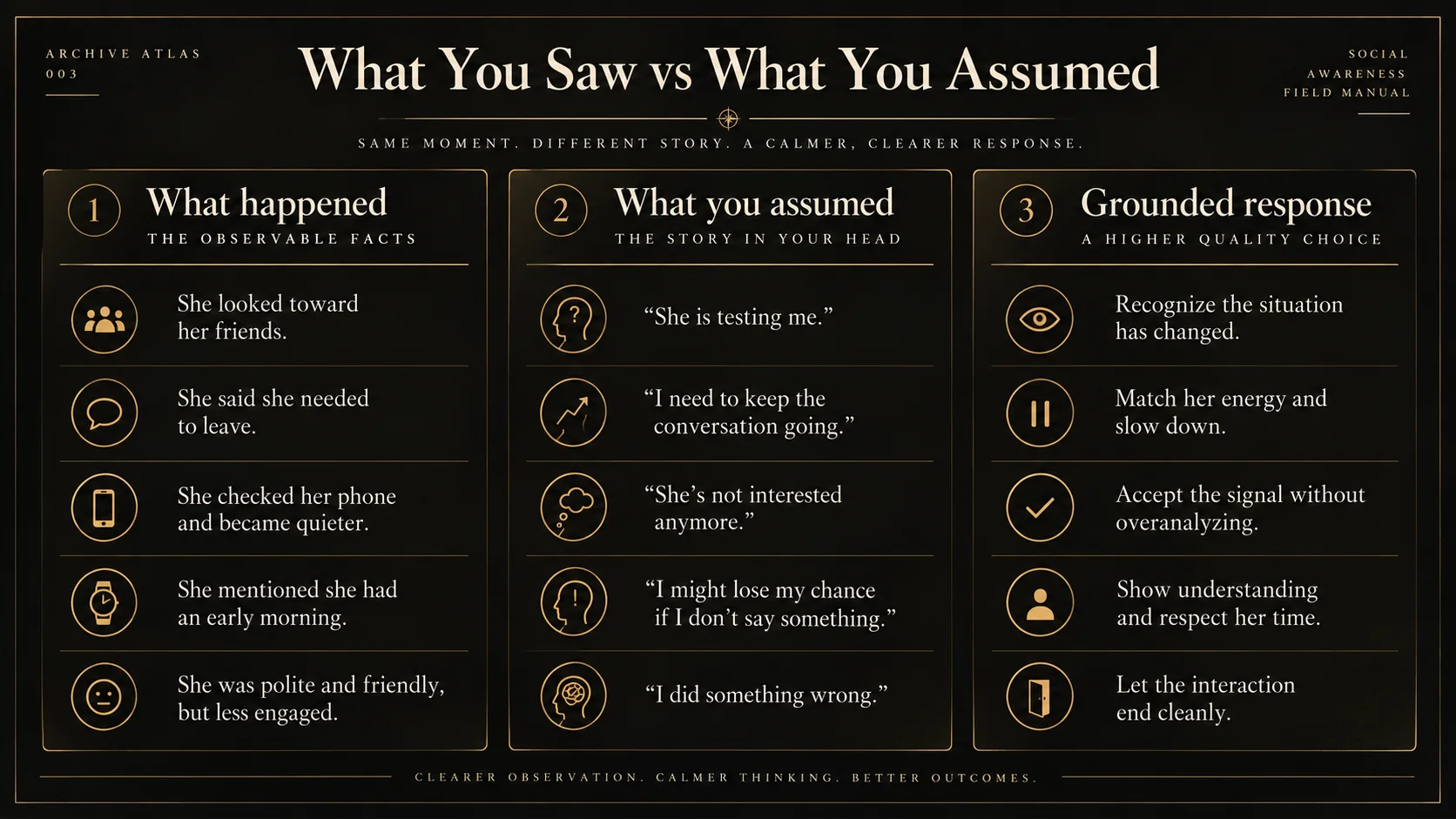
What you noticed. What you invented.
The woman says her friends are leaving. He keeps explaining his point. She answers briefly. He asks another question. The error is not necessarily the question; he has failed to change his response after receiving new information.
Cue Ignorance (Mistake 24) is a failure of attention, not an invitation to decode another person's private thoughts. The manual connects it with Perceived Value Drop and Attention Control.
Art direction: observation is not mind-reading. The readable, interactive examples below are the authoritative version.
OBSERVATION / ASSUMPTION / RESPONSE
WHAT HAPPENED
She said she needed to leave.
WHAT YOU ASSUMED
“I need one more line to change her mind.”
GROUNDED RESPONSE
Acknowledge what she said, and let the interaction end.
Clear statements and boundaries matter more than speculative meanings assigned to expressions or gestures. An ambiguous glance cannot establish attraction or rejection.
FIELD FINDING 05
Respond to clear information. Resist inventing certainty about ambiguous signals.
08 / EXIT — MISTAKE 44
The moment you should have left.
The conversation ends. He says goodbye, but stays nearby, hoping for another chance. Minutes later, he returns with another comment. To him, it feels like keeping a connection alive. In the observable record, he keeps returning after the interaction has ended.
Hovering Shadow (Mistake 44) describes remaining near someone or repeatedly returning after the social opportunity has passed. The manual associates it with Frame Collapse and Emotional Control.
THE NATURAL DEPARTURELeaving is part of the interaction.Respect an ending without trying to reopen it.
“It was good talking with you. Enjoy the exhibition.”
Then leave. If there is clear mutual interest and the setting supports asking to talk again, make that invitation directly and accept the answer without pressure. A respectful exit is not a trick designed to make someone chase you.
FIELD FINDING 06
An interaction should be allowed to end without the other person having to work to end it.
09 / CASE RECONSTRUCTION
Same gallery. Two very different introductions.
The same man notices the same woman at the same social event. The improvement is not a more powerful sentence. It is a different sequence of decisions.
VERSION A / REACTIVE
The sequence that fails
He rehearses until the moment feels urgent.
He approaches from behind and interrupts.
He closes the distance, then speaks faster.
He ignores her stated plan to leave.
He remains nearby to restart the exchange.
His conclusion: “My opening line was weak.”
VERSION B / CONTROLLED
The sequence with fewer errors
He notices the existing conversation and waits.
Later they encounter the same installation.
He approaches visibly, leaving room.
He exchanges a few comments without rushing.
When she needs to leave, he says goodbye.
His conclusion: “I responded appropriately to the situation.”
Neither version proves whether attraction exists. What changed is observable: he checked the context, avoided an interruption, stayed attentive, and accepted the end of the encounter.
10 / THE DIAGNOSTIC DIFFERENCE
What the Reactive–Control Model actually adds.
A generic approach guide might prescribe stronger eye contact, better posture, or a more memorable opener. It would not necessarily separate the six distinct errors in the gallery example.
Reference Manual 001 connects behaviors to different failure modes and corrective variables. Those classifications are an editorial framework for examining conduct, not scientific diagnoses of someone's psychological state.
OBSERVABLE MISTAKEFAILURE MODECORRECTIVE FOCUS
Back-Approach ShockPerceived Value DropAttention Control
Conversation InvasionFrame CollapseEmotional Control + consistency
Space Violation ErrorFrame CollapseEmotional Control
Cue IgnorancePerceived Value DropAttention Control
Hovering ShadowFrame CollapseEmotional Control
THE USEFUL DISTINCTION“It went badly” describes an outcome. “I interrupted a conversation” identifies a behavior you can correct.
11 / PRIVATE FIELD EXERCISE
Your sixty-second first-impression audit.
Think of an interaction you remember clearly. Choose what you actually observed rather than assigning motives. This tool selects from a fixed, editorially written response library; it uses no AI and sends no data to a server.
The goal is not to explain every disappointing introduction. Some people simply aren't interested. You are assessing your own preventable behavior, not demanding a positive result from someone else.
12 / WHAT THIS ONE CASE DOESN'T COVER
First impressions involve more than an approach.
The manual also indexes posture, hand placement, visible habits, gait, facial expression, grooming, and mismatched social energy. These subjects deserve more detail than one gallery encounter can provide.
MISTAKE 45
Environment Etiquette Slip
Being polite to someone you find attractive while dismissing service staff or others.
MISTAKE 42
Emotional Spillover Error
Carrying unresolved frustration into a new interaction.
MISTAKE 43
Friend Circle Snub
Treating companions as though they are irrelevant.
A reliable behavioral standard should apply even when you're not trying to impress someone.
13 / FROM ATLAS TO REFERENCE MANUAL
One social encounter is instructive. A reference system is reusable.
This Atlas followed one approach through four stages and examined selected mistakes. The complete book indexes 101 mistakes across nine categories, including 13 in Body Language & Presence and 11 in Approach & Timing.
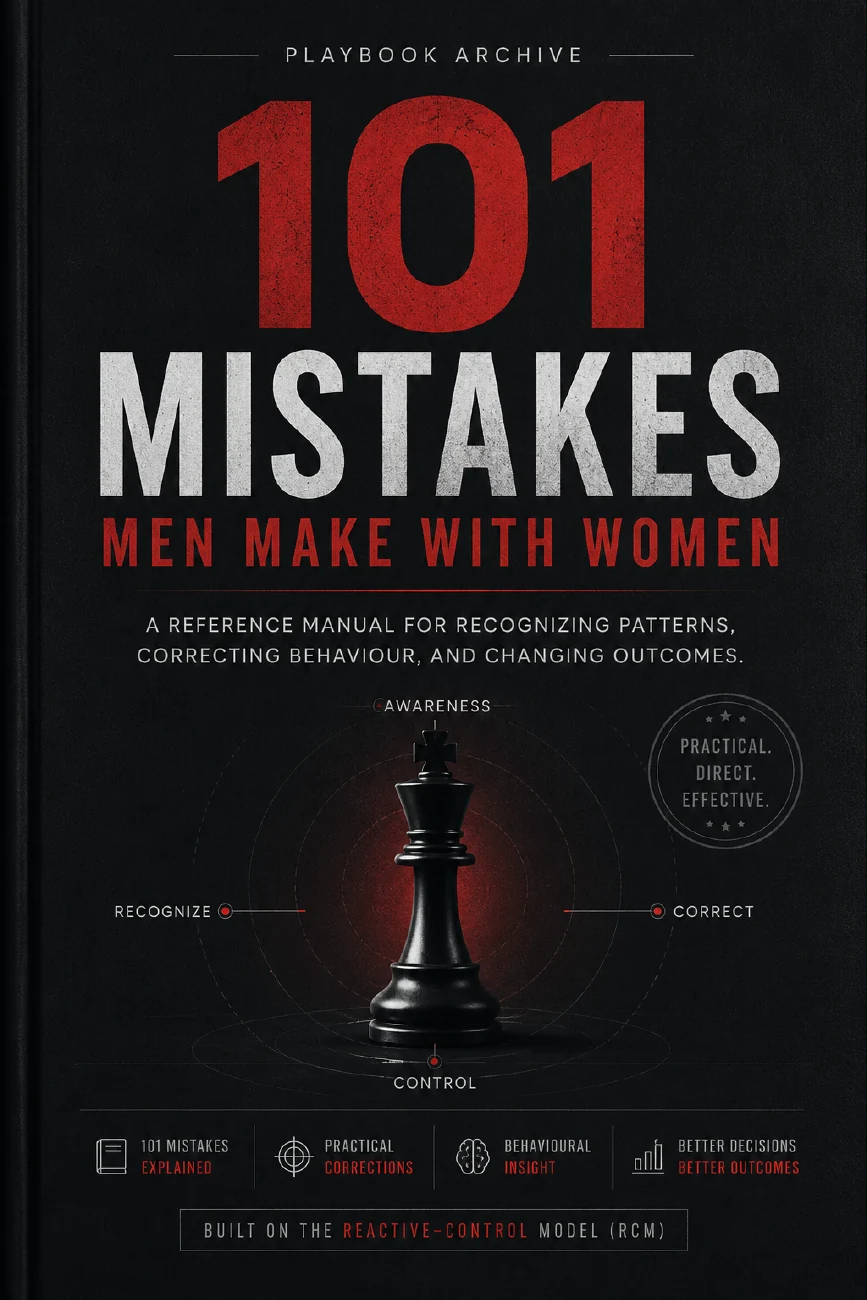
PLAYBOOK ARCHIVE / REFERENCE MANUAL 001
101 Mistakes Men Make With Women
Find the particular error, examine its mechanism and RCM classification, and return to the relevant correction rather than guessing about what went wrong.
101 indexed entries9 categoriesField Companion included