
MISTAKE 27
Interrogation Mode
You introduce new questions because questions feel safer than participating in an unscripted exchange.
Examine this mistake →
The question wasn't necessarily wrong. It may have arrived before the last answer had a chance to become a conversation.
The problem wasn't always what you said. It may be how you kept speaking.Field observation / Atlas 002
You're sitting across from someone you wanted to meet. She mentions that her sister has just moved to the city.
You acknowledge it, then ask about her job. She answers. You ask where she grew up. Another answer.
The conversation slows, so you start telling a story about your last holiday. Several minutes pass. Nothing terrible has happened, but the exchange feels more like work than conversation.
You decide you need better questions, more interesting stories, or a stronger personality.
That is the problem behind several distinct mistakes examined in 101 Mistakes Men Make With Women, PlayBook Archive's first reference manual. Some men ask questions too quickly. Others dominate with stories. Some apologize for harmless remarks or rely on rehearsed lines. They do not necessarily share the same cause. They need different corrections.
Before attempting to improve a conversation, isolate what actually happened. Switch between the exchange, the diagnosis, and a possible correction.
One café conversation. Three ways to inspect its behavior.
These are fictional illustrations. Neither exchange establishes what the woman thinks or how attracted she feels.
Unrelated questions arrive before the earlier answer can develop.
He uses the reference to his own work to take over the exchange.
Questions are structured for brief answers rather than connected discussion.
Possible causes are hypotheses about his conduct, not confirmed explanations for her response.
One correction, not another script: Notice what the other person introduces. Respond to that subject. Add a relevant observation or experience. Allow the exchange room to develop.
Instead of "Cool, what do you do?" after hearing about the sister, he follows the move and lets the answer lead the conversation.
Success means his behavior changed. It does not mean another person must become interested.
Three errors can produce a similarly disconnected exchange. They are not interchangeable, and learning another opener is unlikely to correct all three.
You introduce new questions because questions feel safer than participating in an unscripted exchange.
Examine this mistake →Your stories occupy the conversation, leaving little opportunity for the other person's experience.
Examine this mistake →Your questions repeatedly invite short factual answers, then leave little to build upon.
Examine this mistake →Questions are useful. They invite information and help two people discover things about each other. They can also become a way to avoid contributing.
When asking becomes continuous, the speaker has a defined next move every time. He doesn't have to risk an unexpected personal contribution or tolerate a pause. The exchange starts feeling like a questionnaire.
In the manual, Interrogation Mode is associated with Validation Debt, its first failure mode, and Validation Independence, its fourth control variable. In ordinary language, some rapid questioning may be driven by a desire to avoid uncertainty or keep receiving reassuring responses. The transcript alone cannot prove someone's motive.
Her: “I've been helping my sister move.”
Him: “Did she move here for work?”
Her: “Yeah, she got a new job.”
Him: “That's a big change. Is she settling in?”
The correction is not to invent a perfect question. It is to remain with the answer long enough to discover whether there is anything worth exploring.
The opposite problem can arise from similar discomfort. Instead of asking another question, you begin another story. You talk about work, travel, your family, and the projects you've completed.
Everything may be interesting. Yet interesting material can still be poorly placed.

The subject that disappeared
“My sister moved back after five years away.”
You start talking about your brother, then his last holiday, then your family. Five minutes later, her story is gone.
The problem isn't that you spoke about yourself. You replaced the topic she offered.
Autobiography Flood is also classified under Validation Debt in the reference manual. Storytelling can be a predictable way to manage uncertainty. As long as you're speaking, you know what happens next.
Finish your point without immediately beginning another. Return to something the other person introduced. The manual suggests a thirty-second self-check to interrupt excessive storytelling; it is a practice aid, not a rule for timing every anecdote.
Not every conversational failure comes from too many questions. Sometimes the question itself leaves little room for development.
“Yeah.”
“It was.”
“The little town we found on the second day.”
“Completely different from where we stayed.”
The reference manual maps Dead-End Questions to Perceived Value Drop and Attention Control. Within its framework, the issue is partly the limited attention given to what the question invites.
Closed questions have legitimate uses. Some people prefer brief responses. A better question cannot manufacture mutual interest. The correction is to notice when your question structure repeatedly brings the exchange to a stop, and adjust when appropriate.
Questions and stories are not the whole territory. Some mistakes change the feeling of an exchange without dramatically changing its subject.
“Sorry, can I ask something?” An apology offered to secure reassurance is different from a direct apology for actual wrongdoing. Don't apologize for ordinary participation.
She recalls an album coming out in 2016. You interrupt because you remember 2017. Was the detail consequential—or did proving accuracy interrupt her point?
An anecdote landed well on a previous date. Repeating it regardless of context turns conversation into an attempt to reproduce an earlier response.
A prepared line is not automatically wrong, and factual accuracy still matters. The issue is whether the contribution fits the present moment and serves the actual exchange.
Two men can both struggle to sustain an exchange. The first uses questions to avoid a pause. The second keeps asking closed questions without noticing how little they invite. Their visible difficulty is similar. The corrections differ.
| Observable behavior | RM-001 classification | Corrective focus |
|---|---|---|
| Interrogation Mode | Validation Debt | Stop question-stacking to manage discomfort. |
| Autobiography Flood | Validation Debt | Create space for the other person's contribution. |
| Dead-End Questions | Perceived Value Drop | Attend to the structure and purpose of a question. |
| Premature Innuendo | Frame Collapse | Respect context, timing and clear boundaries. |
The Reactive–Control Model separates several kinds of behavioral failure instead of describing all awkwardness as weak confidence. These classifications are editorial diagnostic tools, not proof that a particular psychological cause has been established in an individual case.
Return to the initial conversation. This time, he stays with the subject she introduced and contributes when he has something relevant to add.
Her: “My sister came to town.”
Him: “Nice. Where do you live?”
Her: “North side.”
Him: “What do you do for work?”
Her: “Design.”
Him: “That reminds me of a huge project I worked on...”
Her: “My sister came to town.”
Him: “Oh, so she's new here?”
Her: “Yeah. New job.”
Him: “That's a big change. Is she settling in?”
Her: “Sort of. Hates the traffic.”
Him: “Fair complaint. Did you spend the whole weekend unpacking?”

Judge the changed conversation by the behavior in the transcript. A still image cannot establish what the other person feels.
Neither version guarantees attraction. The observable difference is modest and useful: he listens, remains with the subject, and contributes without taking over.
For one suitable conversation, focus on a single pattern. Don't attempt to repair every habit at once.
Pay attention to what the other person actually says.
Engage with the information provided.
Share something relevant to the exchange.
Let the conversation develop naturally.
Afterward, review your own conduct, not whether the other person was impressed. If the exchange remained one-sided despite attentive participation, that may be information about mutual interest, circumstances, or communication style rather than evidence of failure.
Choose one behavior you observed. Record what happened, then identify one correction worth practicing. This worksheet stays in your browser; nothing is submitted to a server.
This Atlas examines six errors from the manual's Communication Errors section. The full manual covers eleven communication entries and 101 mistakes across nine different behavioral categories.
It includes indexed diagnostic entries, applied examples, RCM classifications, correction protocols, a Quick Fix Index, and a Control Operator Checklist. The available digital edition includes its corresponding Field Companion.
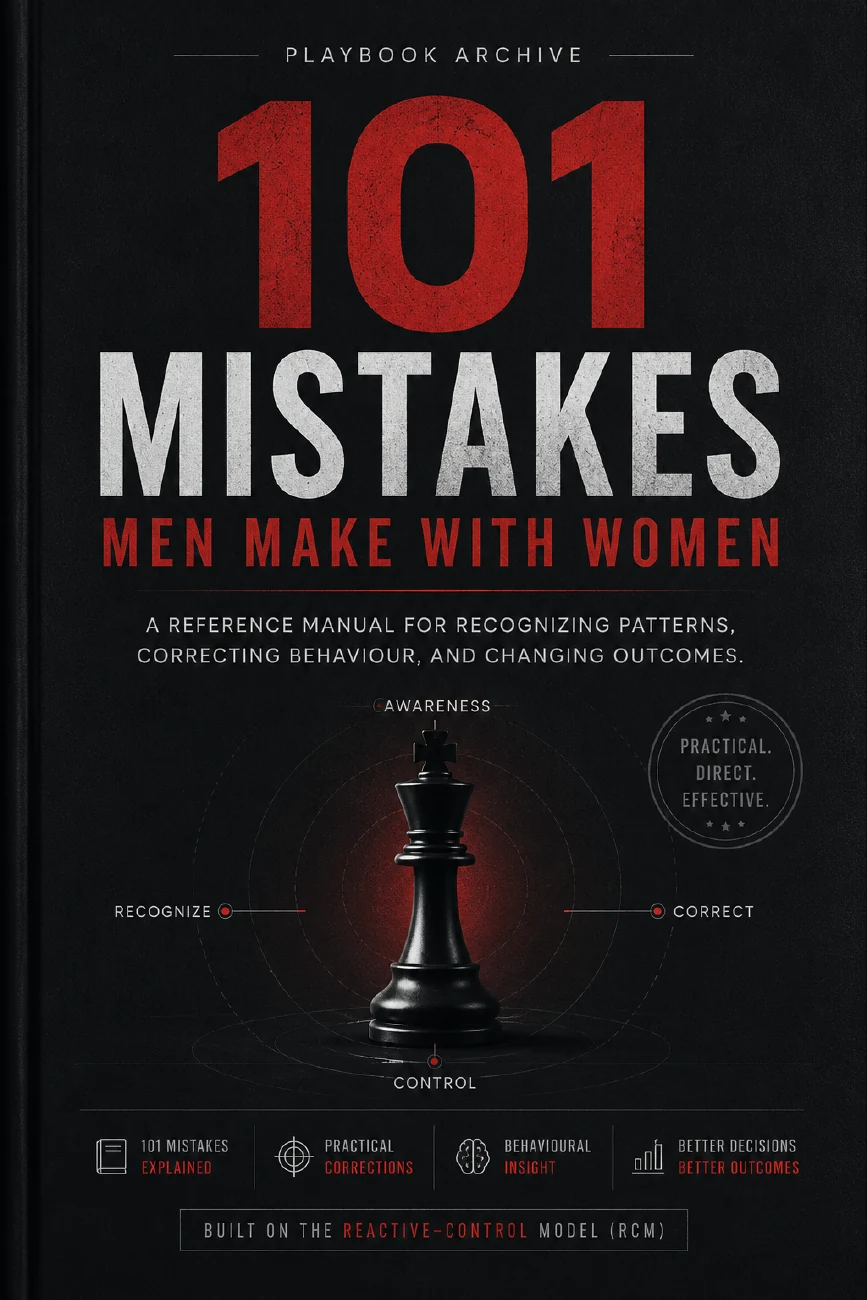
This Atlas examines one conversation. The manual gives you a wider system for identifying the mistake that matches what happened—and returning to the relevant correction.